
2026-10-09 APP 2.0.0-beta48 has been released !
This is mainly a bug fix release for the reported bugs in beta47. In addition it has a significant User Interface performance improvement noticable when you need to process 1000s of images in APP.
2026-10-03 APP 2.0.0-beta47 has been released !
This is a very big release... many code optimizations/rewrites, many parts of APP are much faster and more precise, especially star analysis and registration are much faster ! Big mosaics will go much faster 🙂
And we introduce a new preview filter, which includes the new Adaptive Deep Sky Stretch and a General Levels Stretch, this has been long over due. The old preview filter (the panel on the right side to stretch and preview your data) has not been updated for a couple of years and it is a critical part of any APP session.
Adaptive Deep Sky Stretch or ADSS is a much more intuitive stretch algorithm. It is also color preserving (which is a great new addition in itself ! ) which means that the highlights are no longer bleached, color is maintained from the linear data while stretching. You can simply stretch your data using the sky background level and signal width sliders which work much easier and more intuitive. You no longer need to fiddle with the old complicated sliders with zoom buttons. All the zoom buttons for the sliders are made redundant. And you can enter slider values in the slider value fields yourself. I will make a youtube video in the coming days to explain and fully introduce ADSS. Once the video is ready, it will be highlighted on the forum.
RGB Combine upgrade !. The RGB Combine Tool has been rewritten mostly. The tool is faster and easier to use and most importantly, the Luminance slider to inject a luminance channel or channels into the RGB composite is now working correctly. It no longer bleaches the RGB colors. Combined with the new ADSS preview, you will get much better and easier great composites with great color! I will also explain this in a new youtube video.
Release Information
1
Posts
1
Users
0
Reactions
8,046
Views
Topic starter
July 27, 2017 20:10
Astro Pixel Processor 1.050
- FIXED, windows installer is now code signed with an EV certificate.This should have solved the installation problems of APP with Norton Security/Anitvirus or other security software installed and/or Operating Systems that don’t allow installation of an untrusted application (Windows 8 and higher). If you were experiencing these problems, please contact me at support@astropixelprocessor.com to have your 30-day TRIAL license restarted.
- Fixed, removed null pointer exception in preview filters 8bits,16bits,32bits which could sometimes pop-up while browsing quickly through the frames in the frame list panel.
- Fixed, BPM creation, in 1.049 the statistics method used was not appropriate to determine the standard deviation/noise in the darks for creation of a good Bad Pixel Map. Bad columns weren't detected especially.
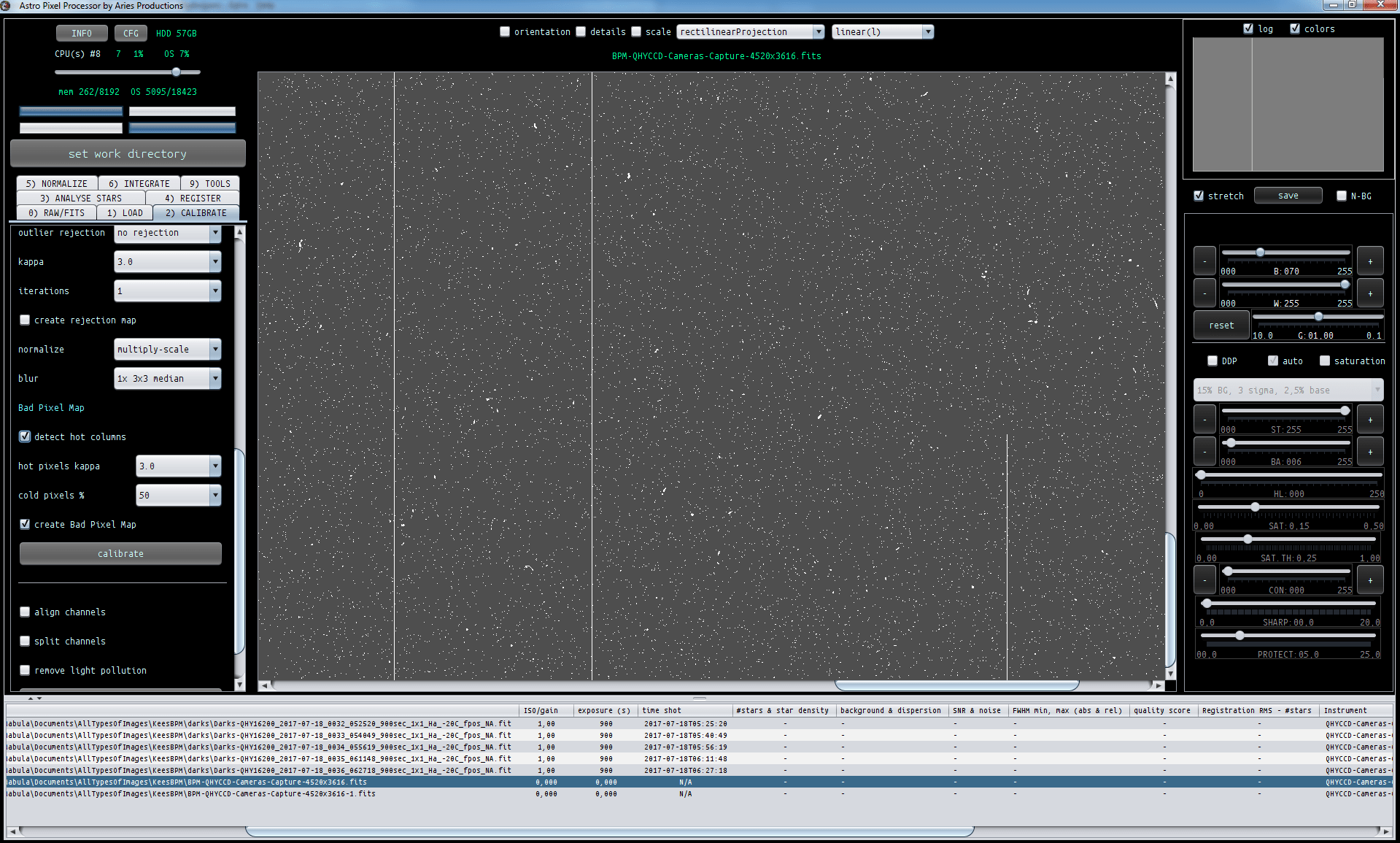
- Improvement, BPM creation, added hot column detection for CCD sensors. This will significantly improve the handling of hot columns in calibration. First image: masterdark of 5 darks of a QHY16200 CCD camera showing bad/hot columns. Second Image: BPM of the same 5 darks without hot column detection, notice that 2 of the columns are only partially picked up as hot/bad pixels. Third image: BPM of the same 5 darks with hot column detection, notice how the bad columns are picked up completely now.


- Fixed, FITS loader, fits files created by EasyCAP of QHY don't follow FITS conventions at all for TIME and DATE (of exposure) TAGS. These files can now be loaded however with a correct interpretation of the date of capture. Previously, an error popped-up.
- Improvement, when loading a Bad Pixel Map into the image viewer, it's always loaded with the Black point at 0, White Point at 255, Gamma at 1 and all DDP settings are ignored. So the previewfilter will always load the Bad Pixel Map with fixed settings.
- Improvement, mosaic registration needs some adjustments of default settings in most cases, APP will ask the user about the following settings to be altered or not and why: disable "same camera and optics", enable "dynamic distortion correction", increase "scale stop" to 10 at least.


- Improvement, during long tasks (i.e. star analysis, registration, normalization, integration) the console panel is popped-up after 5 seconds, but it's no longer forced to the foreground for the remainder of the task.
- Added, the possibility to use JPGs as light frames and calibrate, register, normalize and integrate them is added by request. ONLY DO THIS WHEN YOU DONT HAVE any other option like FITS, TIFF or RAW files for data collection. USING JPGs must be considered as a last resort possibility. JPGS have compressed and non-linear data (in most cases) so using JPGs as light frames or calibration frames is not recommended at all.
- FIXED, in data integration, an ArrayIndexOutOfBoundsException could occur if the user tried to integrate calibration frames that didn't have the same image dimensions. Frames that don't have the same image dimensions should never be integrated for calibration purposes. This error is now caught and the user is warned. Then the integration is cancelled cleanly.
- FIXED, user interface image viewer, while zooming in/out on an image with the left/right mouse button, APP now immediately releases memory and stops the current image resampling task. The effect is that zooming in/out is smoother now and won't consume as much memory and cpu cycles as it used to.
- FIXED, image viewer modes l-c-registered, l-c-r-normalized, user can now correctly use equirectangular projection if calibrated projective registration mode was used.
- UPGRADE, 2-view registration, introduced 4 different distortion models in the best registration hypothesis expansion fase. Depending on the amount of optical distortion, APP will increase the model from 1-4. Models 3 and 4 will only be used in case of very significant optical distortion. So APP will only upscale the model if needed. This will give you much more robust results in case of extreme optical distortion. For instance with focal lengths shorter than 50mm.
