
UPDATE FROM MABULA
I have had a very rough 2 months unfortunately health wise. I was struck 3x in a row with bacterial infections. The second infection occurred after a routine hospital checkup and I became very sick. I had to rest and take a lot of antibiotics. Once I was recovering and restarting work 1 month ago, I again became sick. The infection was not yet gone, so even more antibiotics and rest was needed. Needless to say, it took a lot of my energy and I needed a lot of rest.
Finally, the infection is really gone and my energy is coming back step-by-step now and I have started work again. I am terribly sorry to have kept you waiting for support. I will address all outstanding questions and e-mails step-by step and will be on the forum daily from today.
APP 2.0.0-beta47 will come soon as well, a lot of work was already completed before I became very ill, so the release is also nearly ready for you. Beta47 will be much faster actually. Many workflows will be more than 2x faster, mosaics can even be 10x faster than before because registration really received a major boost... all compared to beta46. Before I release it, I will make sure that everything is working properly and then I will release it.
Hi Mabula and Vincent,
over the past two nights I imaged M31 in two LRGB-panels using an Esprit 80ED. I have read the post on mosaics (which this one is not if I understand correctly), but I keep on getting a hard borderline between the two panels, despite them being imaged at 20% overlap. I used several combinations of MBB and LNC, but none removes this central discontinuity.
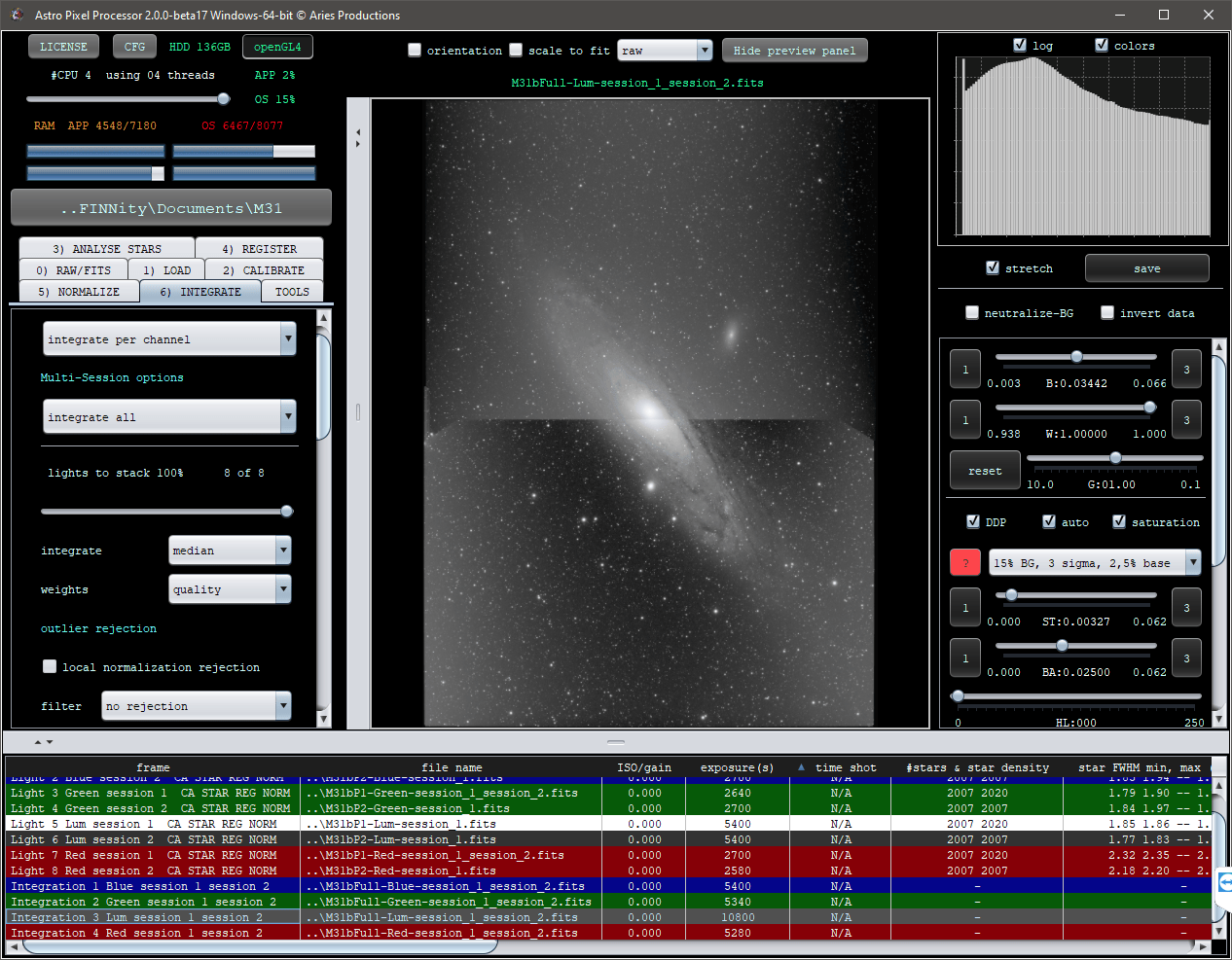
Could you please assist in this? I could upload the 8 images that form the two panels.
Thanks in advance and
with kind regards,
Nicolàs
I got rid of that sharp discontinuity by (when making the separate panels) setting the LNC to 1st degree and 3 iterations, and setting MBB at 7%. Now I still do not get evenly illuminated combined panels after integration and I wonder if it is my data or my processing. I tried several combinations of LNC and iterations, the best was this set (LRGB and the LRGB-combine):
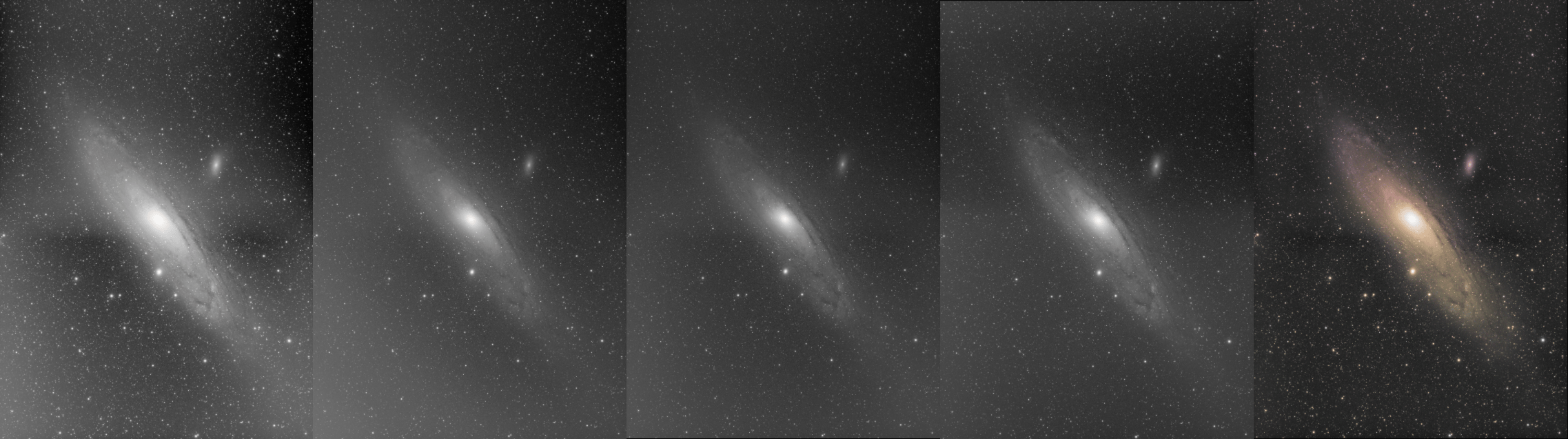
Especially the luminance panel has a terrible dark region at the centre which clearly shows in the combined panel. But in addition the upper panel is more magenta, while the lower is more towards green.
During imaging I started both panels in the same direction of the sky (they were imaged on two successive nights), but there appears to be quite some difference in sky-quality. The following image shows the two luminance panels at their original contrast at the left, which shows that the lower panel has more contrast (due to a better sky?). At the right I gave the lower panel only a linear stretch and contrast:
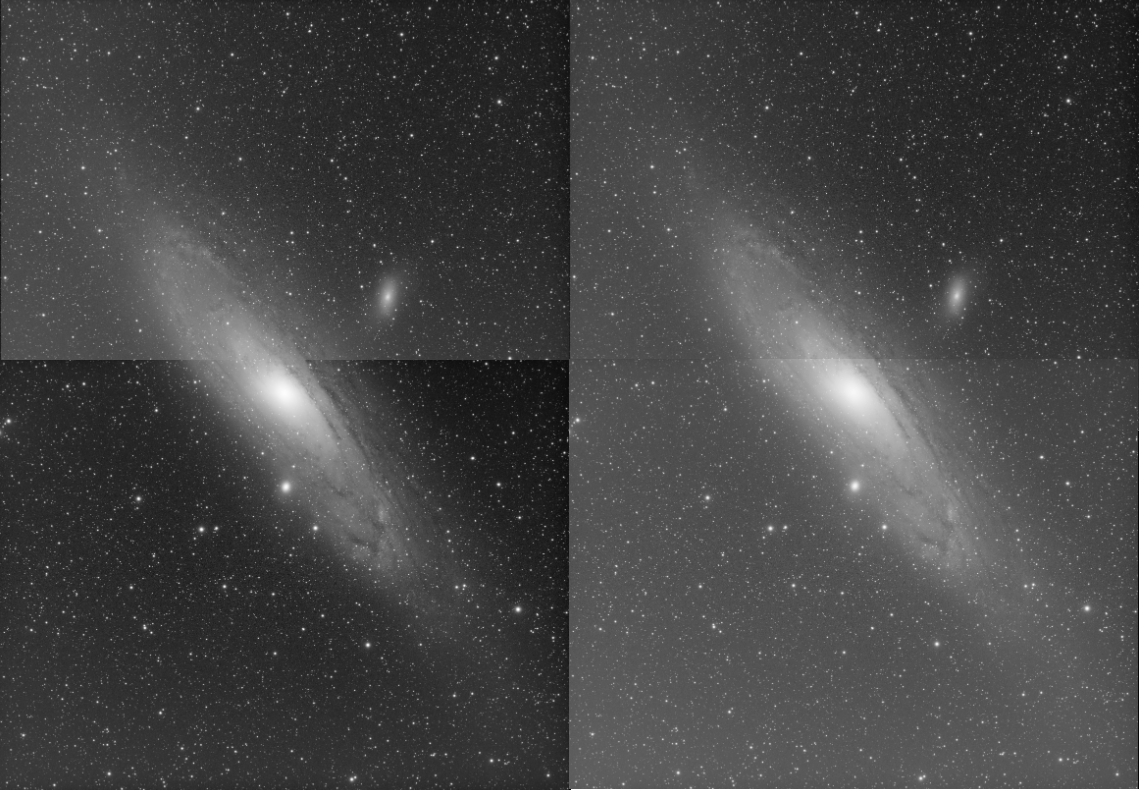
So I wonder: did I do something wrong with normalisation?
In post-processing I managed to squeeze this out of it, but it required very local corrections (i.e. brightening that dark centre due to lum and adjusting the colour for the two panels individually).
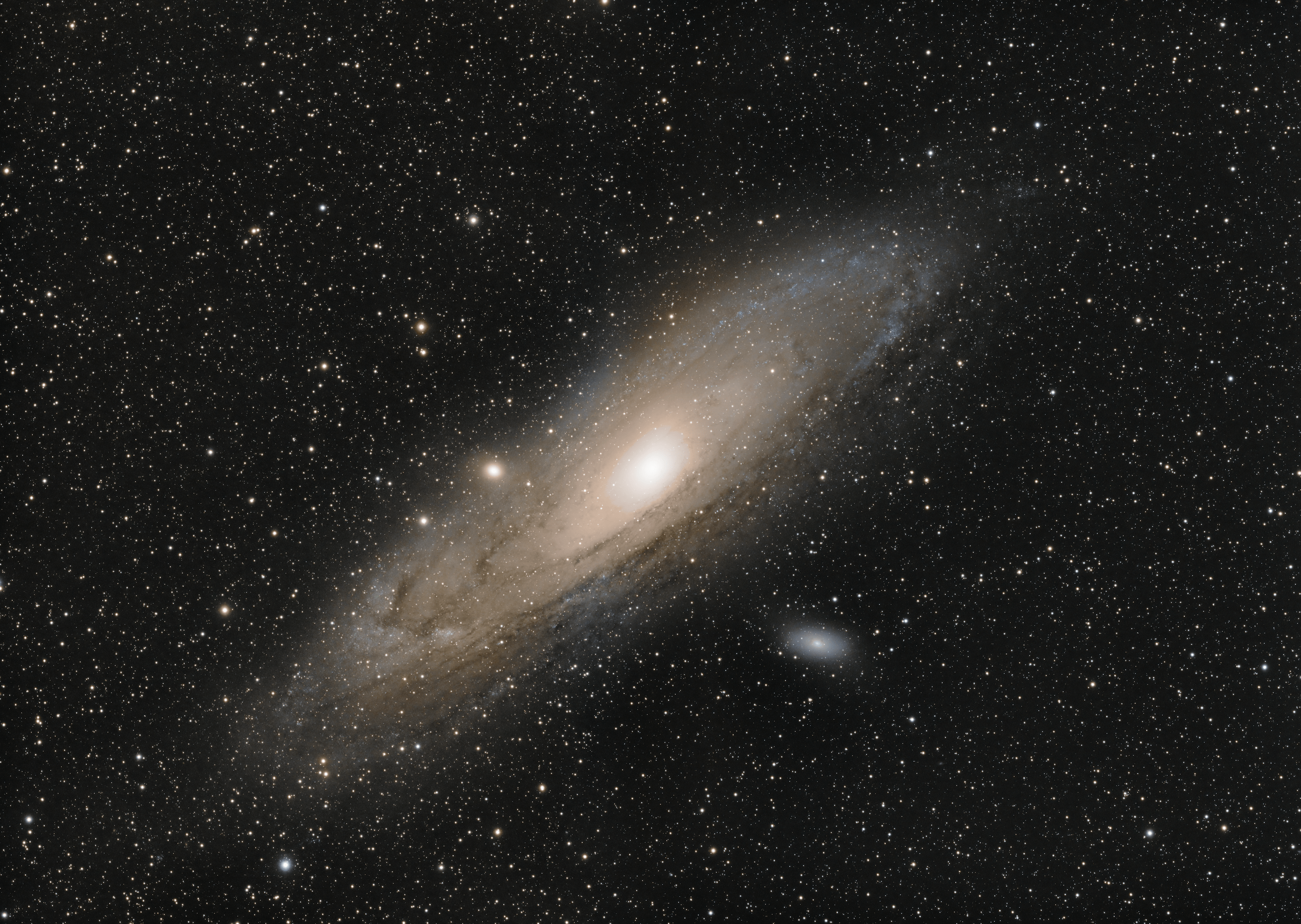
Hope you can supply me with some advice.
Thanks
Nicolàs
Hi Nicolàs @infinnity-deck,
Thank you very much for sharing the issue.
It is in fact an issue on our issue list. Especially our LNC implementation can not deal well with having a bright object like M31's core in the overlap area of a mosaic. We need to fix it and it is on our list to do so.
Your data is beautiful for me to have this tested and sorted out going forward. Can you upload the data here:
https://upload.astropixelprocessor.com/
username: uploadData
password: uploadTestData
Please make a folder like InfinityDeck-Mosaic-normalization-LNC-issue
and let me know once uploaded 😉
Mabula
Hi Mabula,
thanks for coming back on this, good to hear that my data can be of use. I have uploaded the dataset to your server. The filenames speak for themselves (I hope), but just to be sure, the four images per panel are identified by "_P1-" and "_P2-" in their filenames.
Looking forward to your findings and hopefully an improved LNC-routine.
Thanks for all your great work on APP!
best wishes,
Nicolàs
I was about to post a similar issue and came across this thread with the exact same problems.
I have imaged a 4 panel mosaic with the Esprit 150 and QHY600. I'm having the same impossible to solve issue of improperly normalized frames - it would seem as a result of having the core of M31 inside the overlaps of the panels.
I am also having and issue where the panel overlaps have duplicated/blurred stars, and one area where there is a swirl in the center of one panel that makes the stars appear to be in a spiral.
Are these all related to the outstanding issue that you mentioned Mabula? I've attached screen caps of my issues, if these data will not be able to be processed in APP at this time then I guess I'll file them for the future, but that is very unfortunate.
Thanks in advance,
Eric


It is indeed an issue for normalization to have the core in the center, not sure if Mabula is able to work around that, but it's best to try and have the core offset.
I ended up using the 'process each frame separately then mosaic combine' method to get a final image. It worked, but a massive amount of extra work in doing so. Since targets like this, and any others that are bright are often framed as the center of an image, I hope that this is on a priority list for getting fixed. I'm gathering LRGB data on this now, that will be a LOT of work!
Thanks to all for the work, love the APP!
https://www.astrobin.com/ffh9xn/
Hi Eric @flywaldo,
Thank you very much for sharing your issue as well.
The issue with normalization is on our list and is an important once for sure, so it is high on our list.
The other issues:
I am also having and issue where the panel overlaps have duplicated/blurred stars, and one area where there is a swirl in the center of one panel that makes the stars appear to be in a spiral.
the swirl can happen when you enable dynamic distortion correction when the data really does not need it, also an issue on our list that will be fixed.
If registration is off in the overlap areas, you normally need to increase the star count in 3) analyse stars to have that fixed.
Mabula
Hi Mabula,
any progress on this issue?
thanks,
Nicolàs
Hi Nicolàs @infinnity-deck,
No not yet, it is on our ToDo list, but we need to finish work on other priorities first. For this issue to be fixed completely, we need to create new and better LNC algorithms and also improve the general normalization I think. Of course, this is important so this is high on our list to improve and fix.
Mabula
Hi Mabula,
any progress on this issue or an idea about planning it?
thanks,
Nicolàs
I found changing normilization to advanced, turning up MBB to 20% or 25%, and running LNC at least as 2nd degree 3 iterations seems to remove any seams in my mosaics.
This is still crippling for any mosaic attempt where there is a bright area along the transition. Is there any progress towards solving this serious issue? I have tried the process separately technique and it helps, but in final processing the gradients are unavoidable and ruin the image.
Thank you,
Eric

Hi Eric,
thanks for posting, such a shame that two and a half years later the issue remains unresolved... It was (hopefully still is!?) on their issue list in 2023, but apparently not with high priority.
I never tried a two-panel mosaic again as a result of it.
Nicolàs (the OP)
Hi Eric @flywaldo, and Nicolàs @infinnity-deck,
Thank you for bringing this up again. The issue is still on our list, and I want to make serious work of this when I have 2.0 stable and the full manual out, which is forthcoming.
This normalization is very high on our list now combined with introducing LNC 2.0. If you have any mosaic data that created this issue, please upload it to our server and I will make sure that we use it in testing and improving the normalization.
https://upload.astropixelprocessor.com/
username: uploadData
password: uploadTestData
Please make a folder with your name and issue and let me know once uploaded.
Sorry to keep you waiting so long for this one. It is clearly our biggest issue with data normalization, big HDR objects on mosaic seams basically.
Mabula
@mabula-admin I am uploading the HA S2 and O3 stacks to the folder "Eric Walden M42 Mosaic Normalization Failure" now. They should be there in around 20 minutes. The site is very slow, took me 10 minutes to just log in.
Thank you for keeping this on the radar. With the kind of hardware I have being able to do these mosaics is really critical to making the most of the targets available to me.
Eric
Hi Mabula,
I uploaded my data in the past (see https://www.astropixelprocessor.com/community/postid/29225/), but perhaps you no longer have it. Please let me know if I need to upload it again.
Nicolàs
Hi Eric @flywaldo and Nicolàs @infinnity-deck,
The just released 2.0.0-beta41 finally has the improved Local Normalization Correction 2.0 included. I worked intensively in the past 2 months to include this. LNC 2.0 has been developed to make sure that it can handle the bright/HDR objects now. I included weighting for all the sample points in the data and the dark areas will be weighted much more strongly than the bright areas, that solves the problem of the older LNC implementation. It is faster, uses less memory and is way more robust. The results should have flat sky backgrounds and the seams mostly removed. If needed, enable Multi-Band Blending to get rid of still visible seams in your data.
Please look at this example of a 3x3 M42 mosaic in RGB, it has the brightest part of M42 on the mosaic seams. The older LNC could not do this at all because of the bright object and the narrow overlap. LNC 2.0 can do it properly now:

Please let me know if the results are now good on your data.
Hope you also like the clear performance improvements in beta41.
Thank you very much for your patience.
Mabula
Hi Nicolàs @infinnity-deck,
I just processed your M31 data with beta41, it definitely works much better now with LNC 2.0, the algorithm is not confused by the bright core of M31
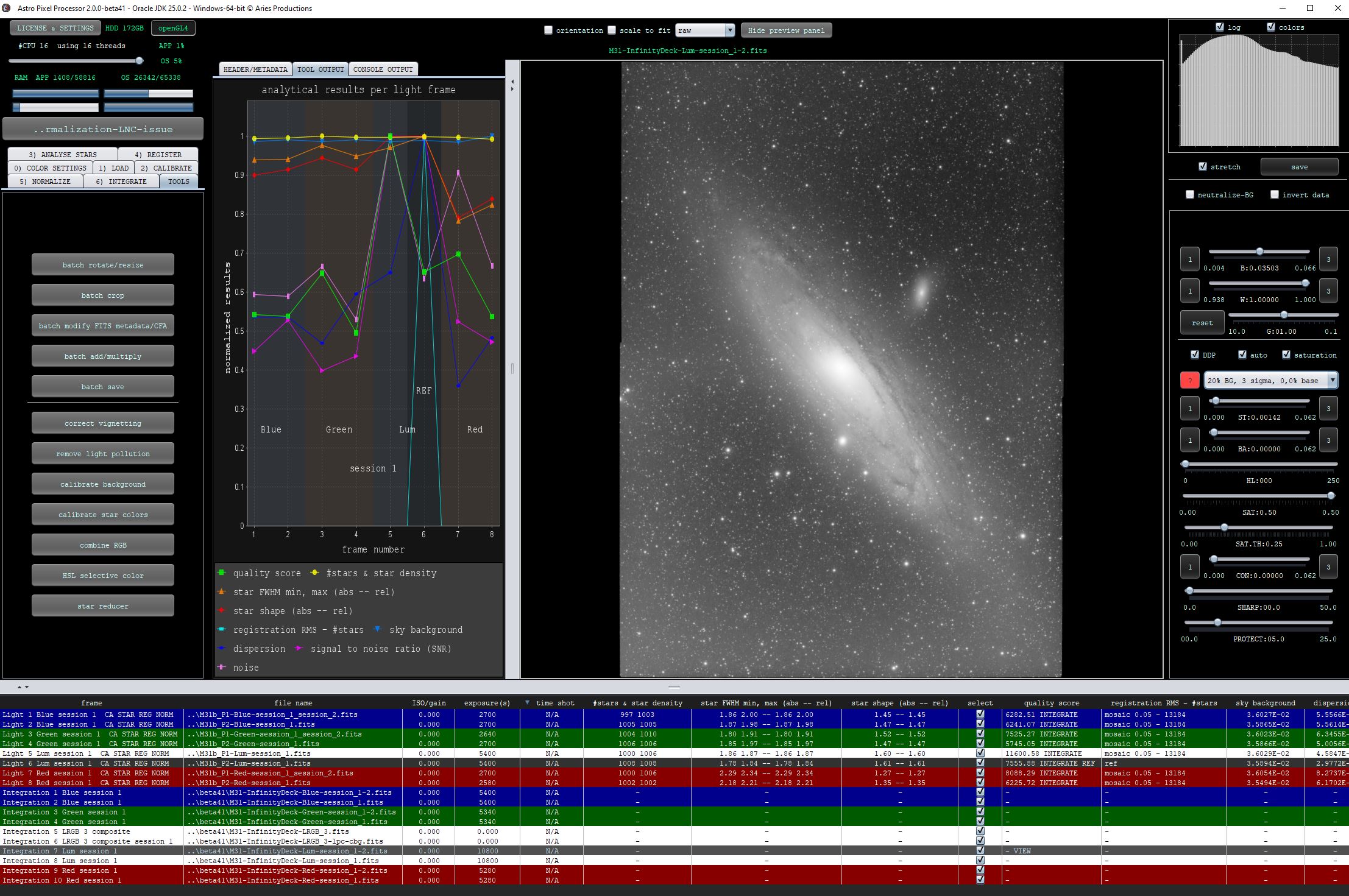
Hi Mabula,
thanks for improving the method, I will give it a try, see how far I can get now. Which settings did you use?
Nicolàs
Oh boy, thank you thank you thank you!
I have so much data sitting in folders now from mosaic attempts that I could never complete processing on. I will install the new version and run the data with the new system and report back. The examples you shared give me great hope!
Thank you again for all of your hard work on this great product Mabula!
Hi @infinnity-deck & @flywaldo,
Hi Nicolàs, I tested LNC 2.0 1st, 2nd and 4th degree on your data. 4th degree was best, but 1st degree was also very close already.
Besides LNC 2.0, I actually also think that I can change the normal and advanced normalization as well, to better handle the bright objects in the data, using my knowledge know if improving LNC.
So please let me know your findings, I can quickly improve 5) normalize as well now in the meantime.
Mabula
Hi Mabula,
I processed the data again, using my original 8 stacks (4 per panel) as point of departure. I used the new LNC with 4 iterations as you did. The result looks way better than before, although we can still see that it is a two-panel image when we look at the result of RGB-combine, remove light pollution and calibrate star-colours (the right-hand side is more purple):
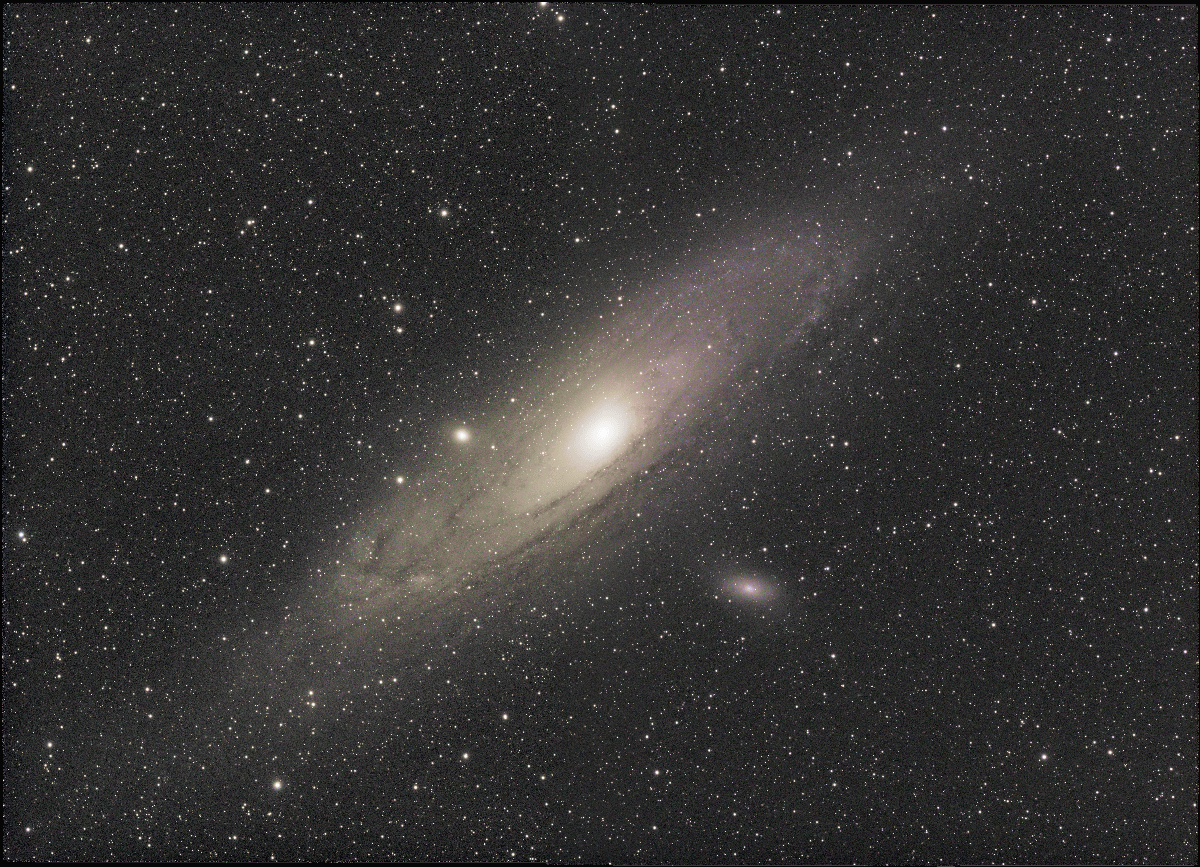
Now I am not sure if this is due to the difference in atmospheric conditions (which was the case at the time) or that further improvements are possible. The difference in tint was easily corrected by selecting half the image (with 200px feather) and applying a slight tone correction.
No matter the cause, the data is way better and easier to process to something agreeable than before:
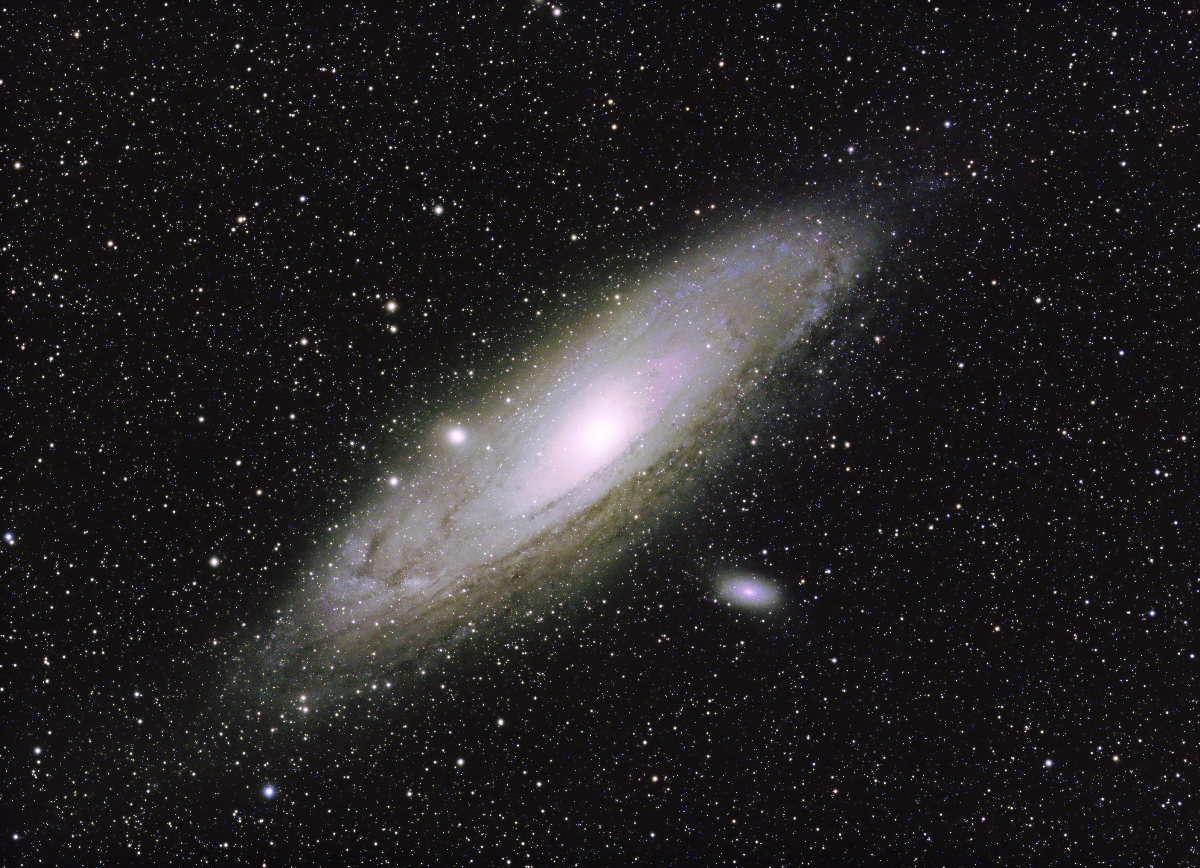
The new LNC makes me considering multi-panel imaging again, so thank you very much for finally improving the method!
best wishes,
Nicolàs
Hi Nicolàs @infinnity-deck,
That already is indeed much better! Thank you very much for testing and your feedback.
Yes, I see what you mean, that color difference is definitely caused by shooting at different imaging conditions. But, if the normalisation would work very accurately, then the color difference should be corrected as well ;-).
I am still working on this after the beta41 release, I am working now in 5) Normalize to actually make the initial normalization better as well. I have already made progress there as well. The key for complete correction lies also in correcting the scale/dispersion robustly for data like this. I am working now on actually masking out the bright objects in the data that gets normalized for lokation, and then use that same mask to also get a more robust dispersion estimage. That already is working more reliably on several datasets that I use for testing including this data set of yours.
Once I have a test version with this, I will be happy to share it with you for testing.
Mabula
Hi Mabula,
Good to hear you are even improving on this, looking forward to test the next version!
best wishes,
Nicolàs
