

2026-10-09 APP 2.0.0-beta48 has been released !
This is mainly a bug fix release for the reported bugs in beta47. In addition it has a significant User Interface performance improvement noticable when you need to process 1000s of images in APP.
2026-10-03 APP 2.0.0-beta47 has been released !
This is a very big release... many code optimizations/rewrites, many parts of APP are much faster and more precise, especially star analysis and registration are much faster ! Big mosaics will go much faster 🙂
And we introduce a new preview filter, which includes the new Adaptive Deep Sky Stretch and a General Levels Stretch, this has been long over due. The old preview filter (the panel on the right side to stretch and preview your data) has not been updated for a couple of years and it is a critical part of any APP session.
Adaptive Deep Sky Stretch or ADSS is a much more intuitive stretch algorithm. It is also color preserving (which is a great new addition in itself ! ) which means that the highlights are no longer bleached, color is maintained from the linear data while stretching. You can simply stretch your data using the sky background level and signal width sliders which work much easier and more intuitive. You no longer need to fiddle with the old complicated sliders with zoom buttons. All the zoom buttons for the sliders are made redundant. And you can enter slider values in the slider value fields yourself. I will make a youtube video in the coming days to explain and fully introduce ADSS. Once the video is ready, it will be highlighted on the forum.
RGB Combine upgrade !. The RGB Combine Tool has been rewritten mostly. The tool is faster and easier to use and most importantly, the Luminance slider to inject a luminance channel or channels into the RGB composite is now working correctly. It no longer bleaches the RGB colors. Combined with the new ADSS preview, you will get much better and easier great composites with great color! I will also explain this in a new youtube video.
Hello,
my name is Chris, I am new to APP an allready stacked a few Deep Sky pictures with it.
I am using a Nikon D750 and I convert the RAW-files with Nikon's Capture NX-D into TIFF before loading the files into APP (reason being the "noise reduction for Astro photos" feature of Nikons converter eliminates all bad pixels and also reduces residual colour fringes arround stars).
I am doing this also with all other frames (all correcion frame exposures).
The 25 flats are integrated in APP "average", multiply-scale, BWMV, no blur, no rejection, noLNC.
When compiling a Master Flat in APP, I run into a problem: The calculated Master Flat, opened up in the central image viewer window, looks all cyan with no typical flatfield pattern at all.
However, when I open the same file in Fitswork, the Master Flat displays as it should.
This "all cyan" problem in APP happens not all of the time, sometimes it works fine, but most of the time it does not. It also displays all cyan when closing APP and opening the MF in a new session. See encloses screenshot.
Since the Master Flat is the most important correction frame, I am wonderng if this is only a display error in the APP image window, and if the MF is still used correctly on the lights?
Or if it does not display correct, it woun't work on the lights?
Thanks very much for your help!
Chris
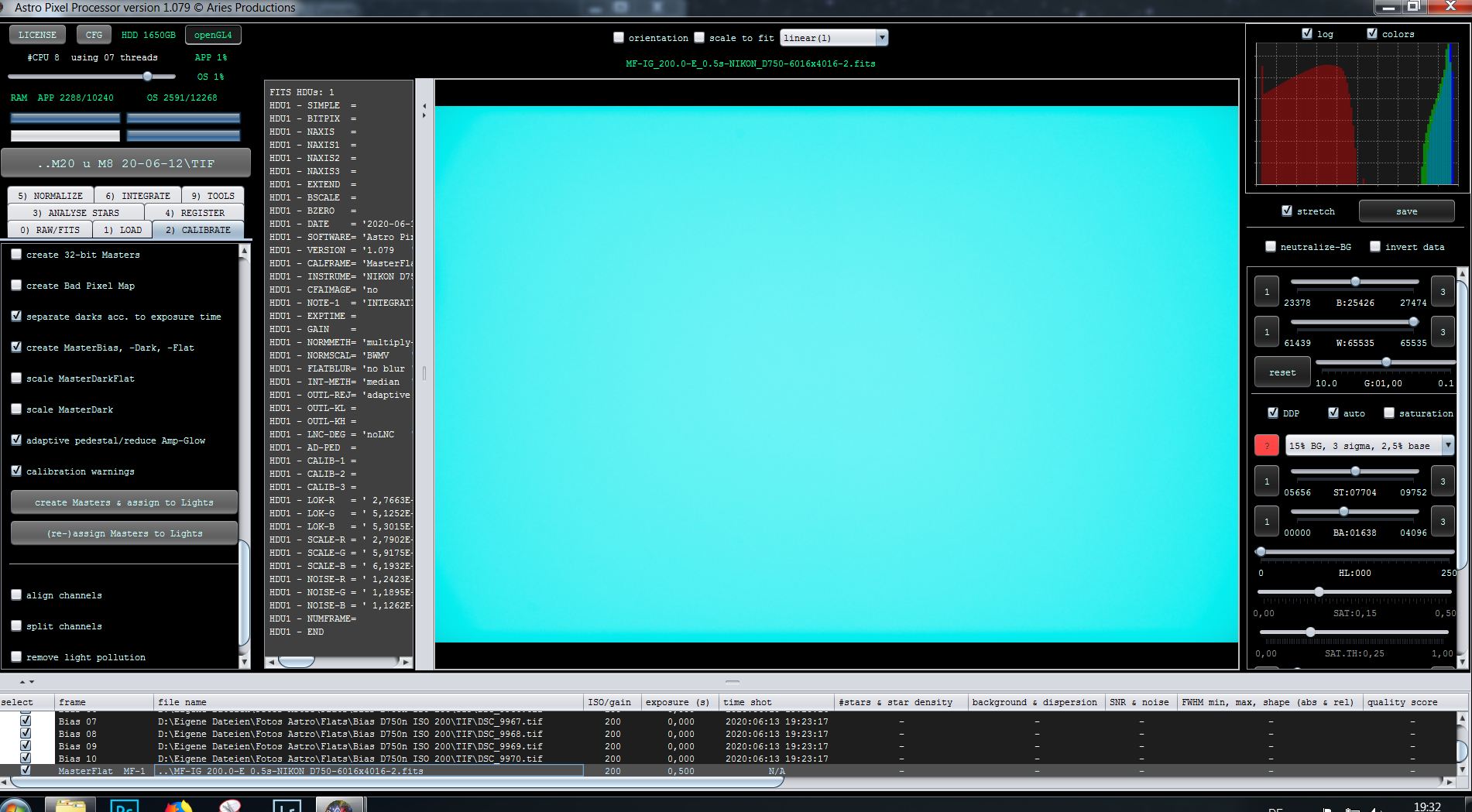
Hello,
my name is Chris, I am new to APP an allready stacked a few Deep Sky pictures with it.
Hi Chris and welcome to the forums!
I am using a Nikon D750 and I convert the RAW-files with Nikon's Capture NX-D into TIFF before loading the files into APP (reason being the "noise reduction for Astro photos" feature of Nikons converter eliminates all bad pixels and also reduces residual colour fringes arround stars).
I am doing this also with all other frames (all correcion frame exposures).
So, my advice; don't do that. 😉 The reason is that APP is made specifically to do that work for you, it has very advanced algorithms made specifically for astro-photography and is able to correct these things in a much better way (almost always), then general processing tools. These tools, more often than not, actually degrade the image quality. You need to use darks and bias calibration frames for APP to do this and load in the RAW files directly into APP.
The 25 flats are integrated in APP "average", multiply-scale, BWMV, no blur, no rejection, noLNC.
When you use 1.079 and onwards, you can just leave the options on automatic and APP will choose the correct settings for you.
So could you try to test this with 1.079 and loading in the raw data? Load in the flats and bias and let it calibrate automatically to see how that looks like.
Vincent,
thanks for your quick reply!
Yes, I was using Version 1.079. I will try directly loading in the NEF-files.
Maybe my flats are flawed, since the histogram of the Master flat shows clipped red and almost saturated blue.
Chris
This is happening to me as well with my Flats. When I load a single or even the Master Flat APP asks to which channel to assign the frame. What is the correct answer there? I seem to always get an all Cyan colored screen with no actual Flat frame artifacts. Unsure of how to proceed.
Dale
The flats should be applied to the session that they were meant for. Usually you take flats after every session.
The strange color artefact, not sure, what happens when you switch off normalization on the right panel and stretch?
Vincent,
When I load a Flat or Master Flat after checking "Force Bayer CFA" and selecting a pattern for the Sensor in 0) Tab, the pattern is mostly Cyan. There are details from the Flat visible, but faint. When I tick the neutralize BG, all the ugliness reveals itself. It almost looks like a rectangle vignette. What can I make of this? And, if the Flats are being extracted from the Integrated file, why does all of this mess show up in the end result of Integration? I'm baffled.
Thank you,
Dale
Vincent,
Here are the Screenshots.


Mmm, that might be a flat issue. I see you're exposing for a very long time, is this due to a narrowband filter perhaps? How exactly are you taking the flats?
For a proper preview, switch off the DDP as well as it shouldn't be stretched then.
I am new to the forum and have another post not exactly related although I can vouch that my flat screen is the same cyan color. All of my files come from the ASIAIR file structure which gets this from my Nikon D5300. No manipulation has been done to the file.
