

UPDATE FROM MABULA
I have had a very rough 2 months unfortunately health wise. I was struck 3x in a row with bacterial infections. The second infection occurred after a routine hospital checkup and I became very sick. I had to rest and take a lot of antibiotics. Once I was recovering and restarting work 1 month ago, I again became sick. The infection was not yet gone, so even more antibiotics and rest was needed. Needless to say, it took a lot of my energy and I needed a lot of rest.
Finally, the infection is really gone and my energy is coming back step-by-step now and I have started work again. I am terribly sorry to have kept you waiting for support. I will address all outstanding questions and e-mails step-by step and will be on the forum daily from today.
APP 2.0.0-beta47 will come soon as well, a lot of work was already completed before I became very ill, so the release is also nearly ready for you. Beta47 will be much faster actually. Many workflows will be more than 2x faster, mosaics can even be 10x faster than before because registration really received a major boost... all compared to beta46. Before I release it, I will make sure that everything is working properly and then I will release it.
Hello
As part of the processing of RGB images, I integrated Blue 120s and 240s.
When I tried two methods, the attached image was displayed in B.
A: Six Blue120s light, 20 flats, 20 dark, 20 darkflat, 20 bias were integrated without multi -session processing. 20 dark and 20 darkflat of 120s were used. After the 120s light processing, six Blue240s light were integrated. 20 dark and 20 darkflat of 240s were used. I used 20 same flat and 20 same bias as 120S .
B: Using multi -session processing, I checked Blue120S Light in Session 1.
I checked light of Blue 240s in session 2.
I checked flats in session 1 and 2.
I checked dark of 120s in session 1, and dark of 240s in session 2.
I checked darkflat and bias in session 1 and 2.
I thought that if I separated the session, each session would be processed independently, but it seems different.
The strange thing is that when light are three in B, the attached image was not displayed.
Therefore, the processing was performed automatically until the end.
The APP version is 1.083.4 for Windows.
The tab setting is the initial value except for the attached images.

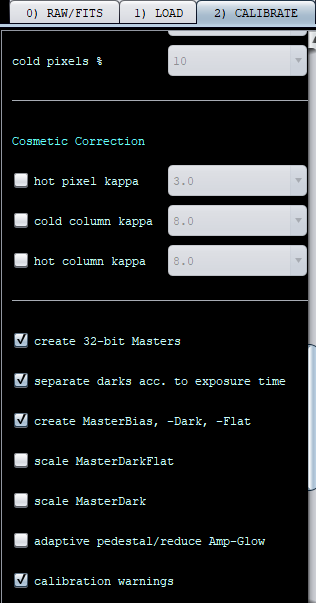
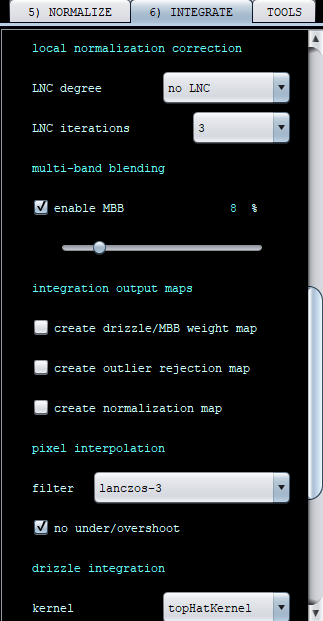
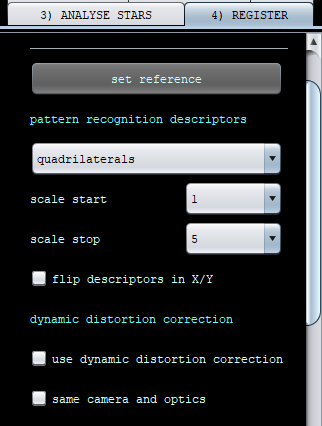
Different sessions are meant for the use of different calibration data you may have per session (usually flats). Looking at the above dialog it shows that you have a master darkflat of 120s exposure, that seems incorrect I think. Did you mix up a darkflat exposure with a dark?
@vincent-mod
Thank you for your answer.
I want to get a good understanding of multi-session processing, so I ask the following questions.
1. Does multi-session processing use session A's calibration file for session B? That is, for other than session A.
2. Can I specify the session to apply them when loading the calibration files on the LOAD tab?
That's all, thank you.
Hello
Interestingly, the A process doesn't show a popup.
Although the light frame and calibration frame are all the same as B.
@mo-mo Using the same flats in multiple sessions isn't working well in 1.083-4 and earlier versions. Please try 2.0.0-beta2 and see if it works there.
@momo: The straightest way to get rid of this error is to take new darkflats (basically Darks with 2.5s exposure). They'll correspond to the Flats just as the darks would correspond to the lights. Each pair requires same exposure / ISO and ideally same temperature (around2°C difference is OK for Darks, the margin is higher for darkflats)
cheers,
jochen
I understand that the same FLAT cannot be used in multiple sessions.
Until the Beta version is official, I'll work with Method A.
Thank you
