
Mar 28 2026 APP 2.0.0-beta40 will be released in 7 days.
It did take a long time to have the work finished on this and it will have a major performance boost of 30-50% over 2.0.0-beta39 from calibration to integration. We extensively optimized many critical parts of APP. All has been tested to guarantee correct optimizations. Drizzle and image resampling is much faster for instance, those modules have been completely rewritten. Much less memory usage. LNC 2.0 will be released which works much better and faster than LNC in it's current state. And more, all will be added to the release notes in the coming weeks...
Update on the 2.0.0 release & the full manual
We are getting close to the 2.0.0 stable release and the full manual. The manual will soon become available on the website and also in PDF format. Both versions will be identical and once released, will start to follow the APP release cycle and thus will stay up-to-date to the latest APP version.
Once 2.0.0 is released, the price for APP will increase. Owner's license holders will not need to pay an upgrade fee to use 2.0.0, neither do Renter's license holders.
Hello everyone,
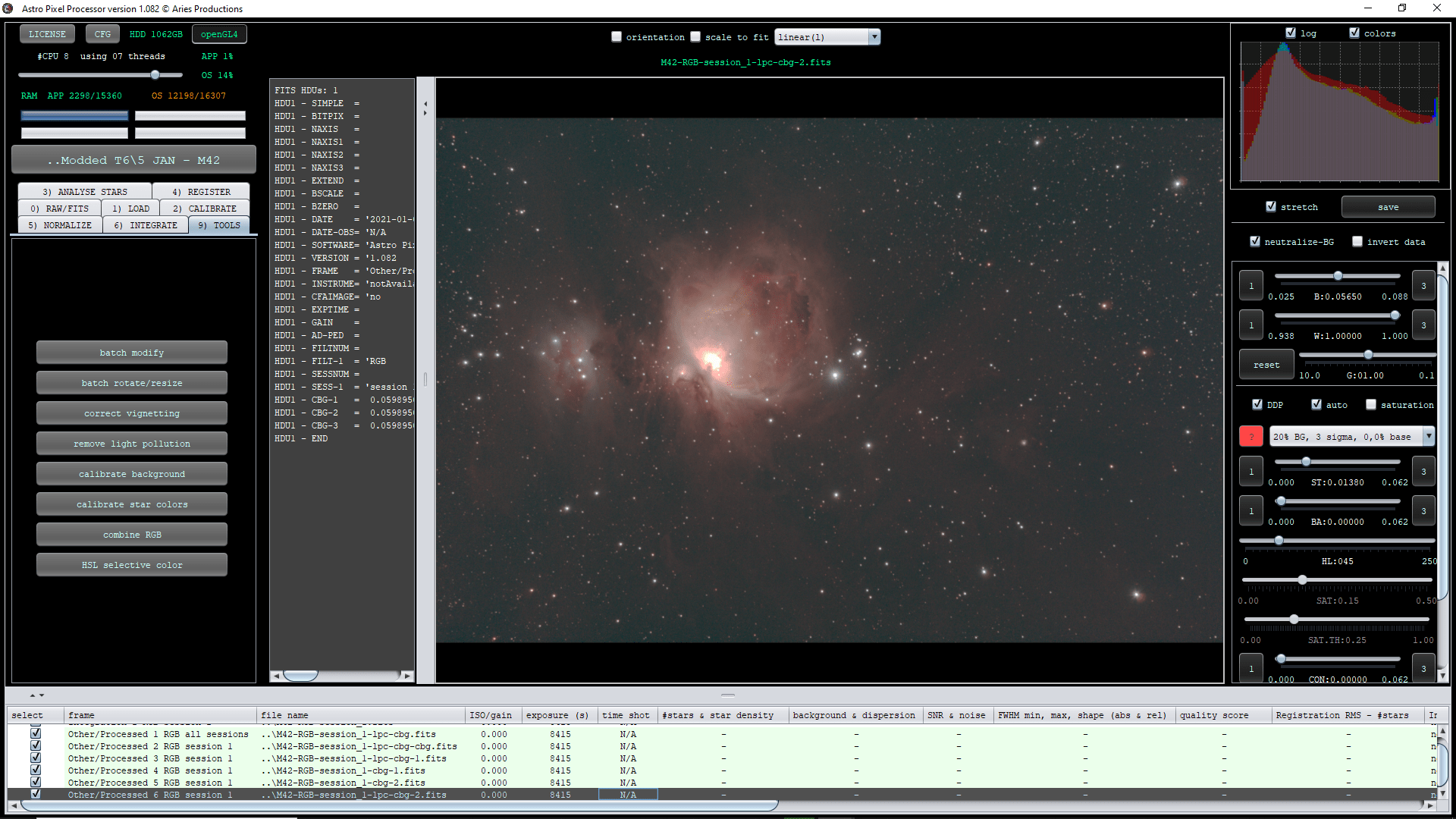
I created this stack the other night of M42 and I can't seem to get the color of the nebula to come out "natural," it either comes out very warm or seems too red to my eye. My understanding is that this would likely be fixed in the star color correction tool, but even after watching the tutorial and reading some other posts about the topic I seem to be floundering. I've attached a screenshot with the light pollution removed and background calibrated image and there's a link to the FITS file if anyone wants to volunteer to see if they can see where I veered off course.
Camera: Modified Rebel T6 (visible + Ha mod from Spencer's Camera)
Lens: Sigma 100-400mm contemporary
Filter: Astronomik CLS clip-in for DSLR
FITS Link: https://drive.google.com/drive/folders/184a74RPx9_WNNlMZ0NFvSpFhoWCGuy8T?usp=sharing
This might be due to the filter. Not sure as it's not a narrowband filter, but the color calibration works for full spectrum data. I would advice to try without that filter. Nevertheless I'll have a look at the data, thanks for sharing.
Ok, so tried it as well. I stretched the preview to the max (30% setting) to see where there is nebulosity (boxes can be best placed in clear area's) and it turned out more natural at least;

I appreciate you taking a look, it's odd because the biggest complaint I've seen about the Astronomik light pollution filter is it shifts everything blue but it seems I've lost a lot of the blue here.
Maybe, blue isn't an easy color to get out usually. The colors in my example do seem right, judging by the stars and the blue around "the running man". The only thing I did extra here was to turn on saturation, but that's not a lot of post processing, you might get a bit more with more processing and enhancing certain colors. More data will help as well of course and I think, since this is a bright target, no filter might even make the result a bit better.
edit: And ps. if you look at my star calibration graphs, it could also be that maybe the slope of that ideal green line, needs to be shifted a little (the cloud of stars in the lower graph might have a bit different trend due to the filter).
So, last one for the night. 🙂 Here I corrected the slope a little and it turned up the blue some as well; you can see in the settings that I dragged the sliders a bit more to the blue and magenta and the slope I changed as well. The green line is where my settings are, the grey line the ideal line for the model. The filter might be the cause of this little shift, but it's not a big issue.

