

Mar 28 2026 APP 2.0.0-beta40 will be released in 7 days.
It did take a long time to have the work finished on this and it will have a major performance boost of 30-50% over 2.0.0-beta39 from calibration to integration. We extensively optimized many critical parts of APP. All has been tested to guarantee correct optimizations. Drizzle and image resampling is much faster for instance, those modules have been completely rewritten. Much less memory usage. LNC 2.0 will be released which works much better and faster than LNC in it's current state. And more, all will be added to the release notes in the coming weeks...
Update on the 2.0.0 release & the full manual
We are getting close to the 2.0.0 stable release and the full manual. The manual will soon become available on the website and also in PDF format. Both versions will be identical and once released, will start to follow the APP release cycle and thus will stay up-to-date to the latest APP version.
Once 2.0.0 is released, the price for APP will increase. Owner's license holders will not need to pay an upgrade fee to use 2.0.0, neither do Renter's license holders.
I have had this happen several times. I always use APP to integrate and for some finishing in PI.
I have the worst problem with this for some reason in either S2 or O3, Ha tends to be fine.
the camera is an ASI1600mc using SGP, Gain139, OS50, 300s for all 3 filters. I use the Ha setting instead of airy disk because I intend to do SHO even though it's a OSC camera and choose "Force bayer CFA", is that the wrong way?
Asking for guidance because this has been bugging me for some time.
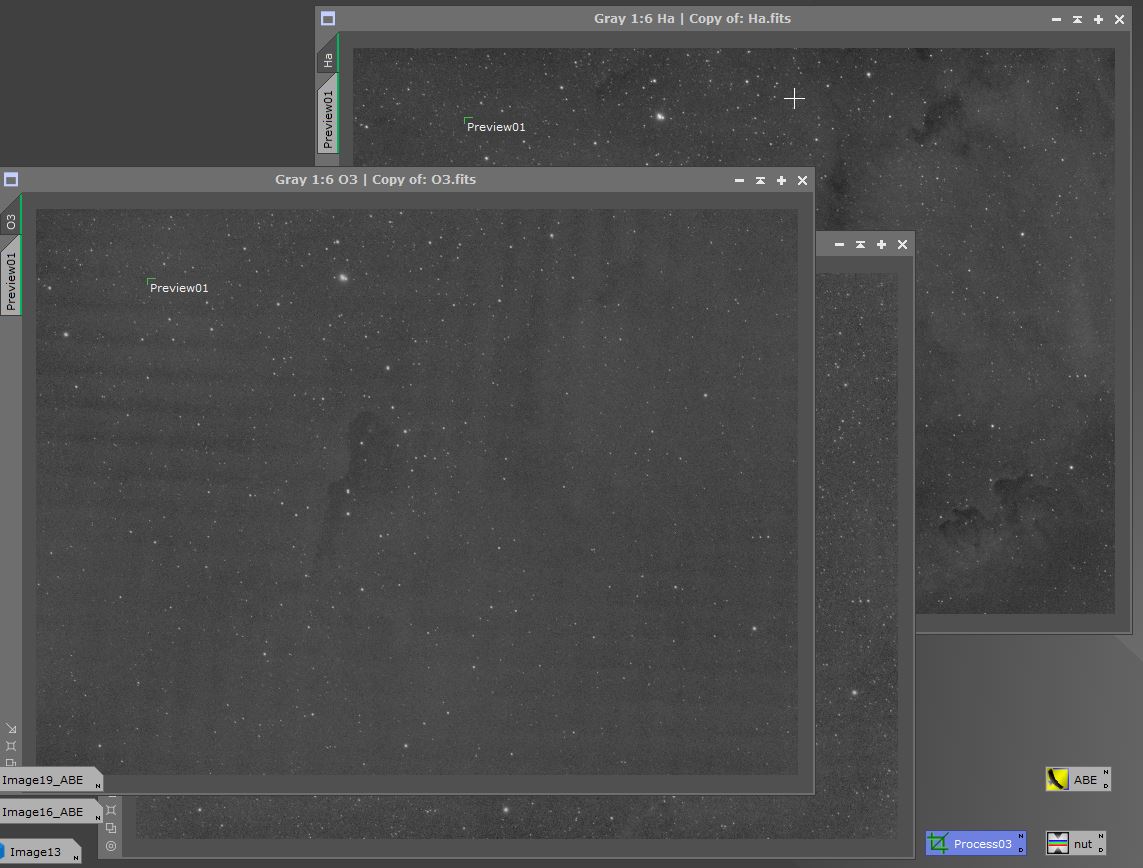
@lite2 What happens if you use Airy Disk for SII and OIII? Do you still get that pattern? Note that Ha-OIII extract Ha is intended to be used with dual band filters and certainly is not suited for OIII. For OIII you may try Ha-OIII extract OIII and see if that helps. If not then you should Airy Disk and then split the color channels manually. This can be done in tab 2. You should then combine the G and B channels for the OIII images into one mono image.
