
2026-10-09 APP 2.0.0-beta48 has been released !
This is mainly a bug fix release for the reported bugs in beta47. In addition it has a significant User Interface performance improvement noticable when you need to process 1000s of images in APP.
2026-10-03 APP 2.0.0-beta47 has been released !
This is a very big release... many code optimizations/rewrites, many parts of APP are much faster and more precise, especially star analysis and registration are much faster ! Big mosaics will go much faster 🙂
And we introduce a new preview filter, which includes the new Adaptive Deep Sky Stretch and a General Levels Stretch, this has been long over due. The old preview filter (the panel on the right side to stretch and preview your data) has not been updated for a couple of years and it is a critical part of any APP session.
Adaptive Deep Sky Stretch or ADSS is a much more intuitive stretch algorithm. It is also color preserving (which is a great new addition in itself ! ) which means that the highlights are no longer bleached, color is maintained from the linear data while stretching. You can simply stretch your data using the sky background level and signal width sliders which work much easier and more intuitive. You no longer need to fiddle with the old complicated sliders with zoom buttons. All the zoom buttons for the sliders are made redundant. And you can enter slider values in the slider value fields yourself. I will make a youtube video in the coming days to explain and fully introduce ADSS. Once the video is ready, it will be highlighted on the forum.
RGB Combine upgrade !. The RGB Combine Tool has been rewritten mostly. The tool is faster and easier to use and most importantly, the Luminance slider to inject a luminance channel or channels into the RGB composite is now working correctly. It no longer bleaches the RGB colors. Combined with the new ADSS preview, you will get much better and easier great composites with great color! I will also explain this in a new youtube video.


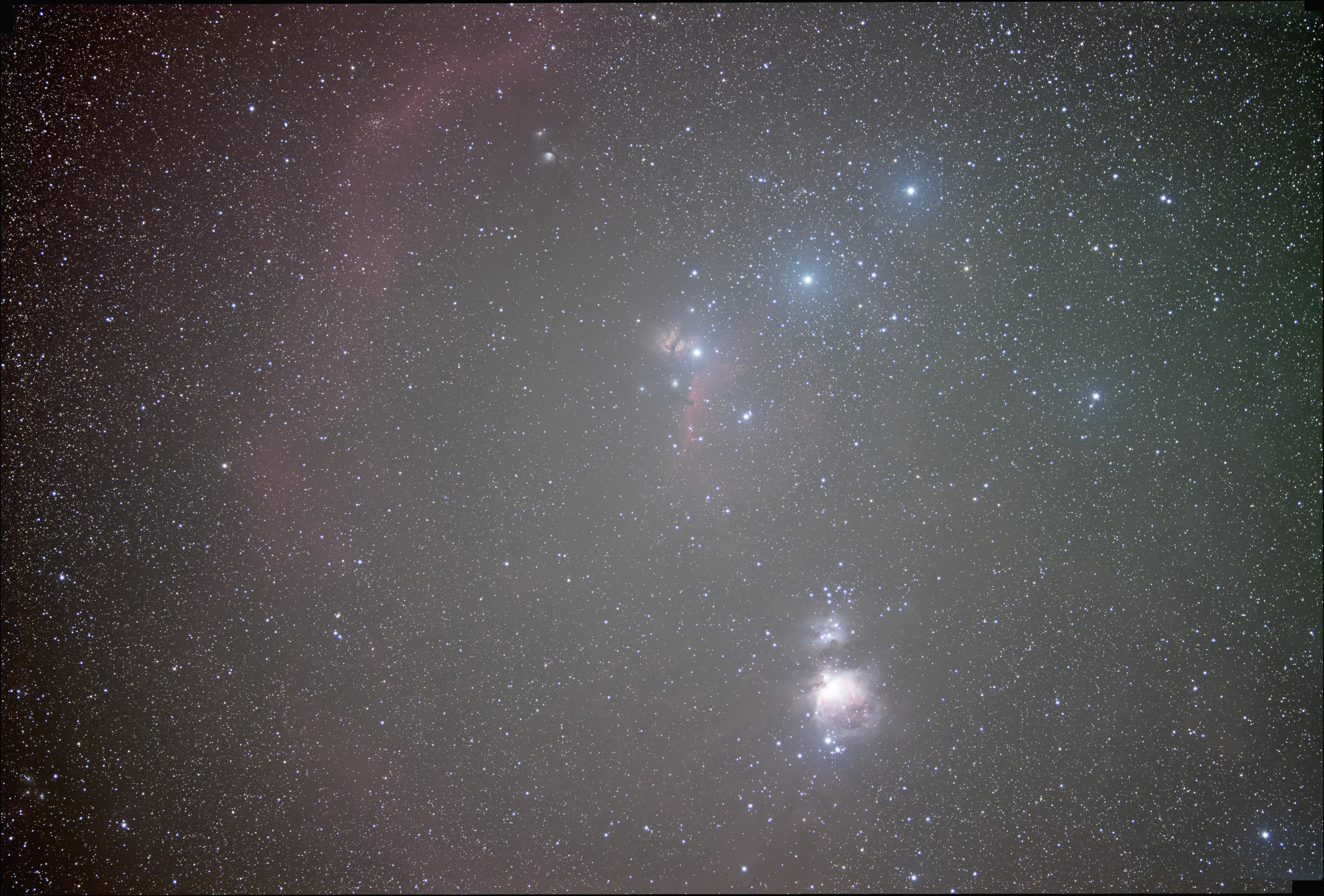
Remote data capture at www.roboscopes.com (Spain) using Pier 4.
Sigma Art 105mm F/1.4 stopped down to F/2
ZWO ASI2600-MC
unguided
mount Astro Physics AP900 GTo3
60x120s plus 10 darks, 100 flats, no bias frames
Calibration/integration/processing with Astro Pixel processor v1.082. SCNR (green noise removal) in Siril to finish.
The second image is a crop, before processing, of the objects from M78 down to M42.
The third image shows the initial stack with severe light gradient.
High res images at my Astrobin account https://www.astrobin.com/mf2ebw/0/
Dave
Also a beauty, keep them coming! 🙂
Thanks Vincent. Removing the light gradient is the tricky part and I think I still have some way to go with that aspect of processing.
I have some more data ordered (60s, 30s, 20s, 10s) for that region and will be experimenting with HDR.
Dave
D
Yes, the gradients look pretty normal to me and should be solved with flats. HDR is unfortunately not yet a tool in APP (planning it though).
I keep going over part 3 of the excellent complete-lrgb-tutorial-of-ngc292-the-small-magellanic-cloud-by-christian-sasse.
For HDR I have stacked frames of different exposure lengths which seems to help. NGC7000 ,30x120s + 45x60s
Is green noise removal coming anytime in the future?
Not specifically that I know off, we might make that easier though. Usually I remove that when doing star color calibration. Or further with HSL, but that is very mild usually, when the new version is out I'll ask Mabula if this is something we can implement in a button. 🙂
