
UPDATE FROM MABULA
I have had a very rough 2 months unfortunately health wise. I was struck 3x in a row with bacterial infections. The second infection occurred after a routine hospital checkup and I became very sick. I had to rest and take a lot of antibiotics. Once I was recovering and restarting work 1 month ago, I again became sick. The infection was not yet gone, so even more antibiotics and rest was needed. Needless to say, it took a lot of my energy and I needed a lot of rest.
Finally, the infection is really gone and my energy is coming back step-by-step now and I have started work again. I am terribly sorry to have kept you waiting for support. I will address all outstanding questions and e-mails step-by step and will be on the forum daily from today.
APP 2.0.0-beta47 will come soon as well, a lot of work was already completed before I became very ill, so the release is also nearly ready for you. Beta47 will be much faster actually. Many workflows will be more than 2x faster, mosaics can even be 10x faster than before because registration really received a major boost... all compared to beta46. Before I release it, I will make sure that everything is working properly and then I will release it.
Hello
When you do a star analyse you get FWHM min, max and shape.
What is the shape related to?
I am sure it is not related to the roundness of the stars, in fact, the frame that APP use as the reference (FWHM min and max very similar) has the greatest value of FWHM shape, so what is this?
Regards
Jose
Hi Jose @skysurvey,
Thank you for your question.
The FHWM shape is the combination of both star size and roundness.
I use the following formula:
star shape = roundness * size
where roundness and size are formulated in a way that better is higher:
roundness = minFHWM/maxFWHM ( so perfect circulair stars have roundness = 1, otherwise the roundness score is lower)
size = 3 / (( minFWHM + maxFWHM)/2) ( so smaller stars have higher size score)
The minFWHM and maxFWHM are calculated per star since they are all fited with 3D intensity profiles.
The value of minFWHM and maxFWHM for the whole image is the median value of all stars that were analysed in the image, giving you a star shape score for the whole image.
And the higher the star shape score, the smaller and rounder your stars are.
I use a general 2D gaussian model to fit all stars to in which I find sigmaX, sigmaY, and rotation angle theta and the model has the shape as shown in this image from one of my presentations:
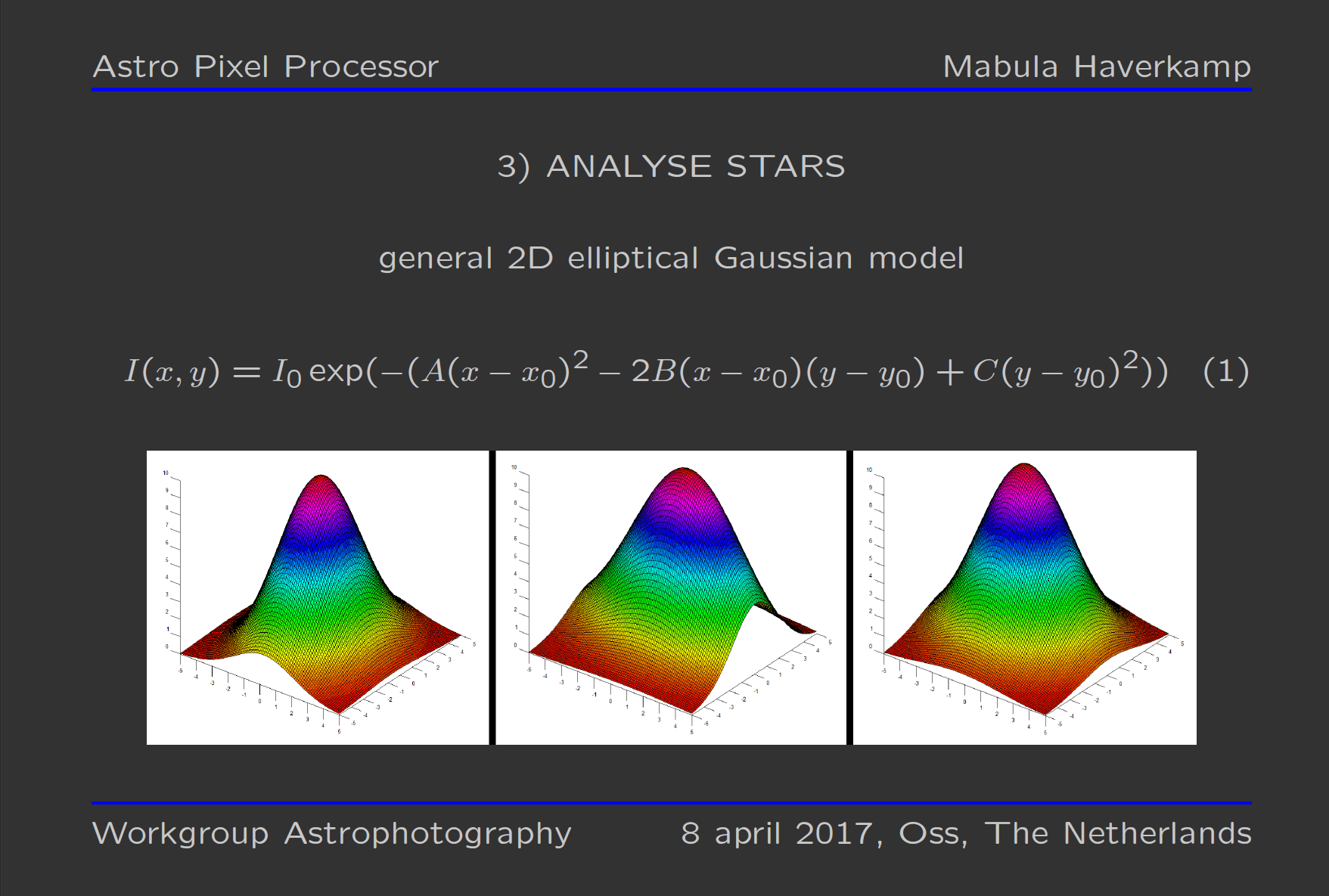
The A,B,C contain the sigmaX, sigmaY and theta.
Let me know if this is clear.
Mabula
Yes!!! It is clear now.
Let me tell you that your brain must be like the Rosetta Stone, I could have been thinking for years trying to know the exact formula without succeeding, but I completely understand the idea, and it works, look at my numbers of a Ceres photograph taken from the middle of Madrid:

So, talking about the best frame (the one used for reference), Min FWHM=1,55, Max FWHM=1,62, and when I apply the formula:
FWHM shape = (6*(Min/MAX))/(Min+Max)= (6*(1,55/1,62))/(1,55+1,62)=1,81 that is the number that appears in the correspondent column of APP, and it is clear, the higher the number the better the star is (better roundness and lower size).
Thank you very much Mabula, I love APP 😉
Regards
Jose
Excellent and thank you Jose 🙂 !
You are most welcome !
Mabula

Hi Susan @safinsd,
As you can see from your uploaded image, eccentricity is not a very intuitive measure of star roundness due to it's non-linear behaviour.
The formula for eccentricity can be found here: https://www.cuemath.com/geometry/eccentricity-of-ellipse/
(1 - b^2/a^2)^0.5
using minFWHM and maxFWHM then the eccentricity formula becomes:
(1 - minFWHM ^2/maxFWHM ^2)^0.5
The Astro Pixel Processor star shape value of 0,8 is more than only star roundness, so you can not compare it directly.
As indicated above, star shape contains both star roundness and star size:
star shape = roundness * size
where roundness and size are formulated in a way that better is higher:
roundness = minFHWM/maxFWHM ( so perfect circulair stars have roundness = 1, otherwise the roundness score is lower)
size = 3 / (( minFWHM + maxFWHM)/2) ( so smaller stars have higher size score)
Now in aswer to your question:
Let us assume that size = 1 (meaning the stars have roughly a FWHM of 3 pixels)
Then star shape = 0.8 means star roundness = 0.8 which then means that minFWHM/maxFWHM = 0.8
entering this in eccentricity formula gives:
minFWHM^2/maxFWHM^2 becomes 0,64
1-0,64 = 0,36
the square root of 0,36 = 0.6
So for stars with FWHM = 3, the star shape = 0.8 gives eccentricity of 0.6.
Please let me know if this is clear.
The Astro Pixel Processor star shape formula containing both roundness and size enables you to directly compare all images to be processed for star size + roundness combined.
Thank you, Mabula. You are far more advanced than me (of course.) I want to prioritize star shape in my subs and had been removing subs with star shape and quality below 0.8 (was assuming star shape of .8 referred to eccenticity), but don't really understand the implications.
Im confused at were does the 6 come from ? I saw the formula in an earlier post that mention's using 3, so I'm kinda confused and must be missing somethingYes!!! It is clear now.
Let me tell you that your brain must be like the Rosetta Stone, I could have been thinking for years trying to know the exact formula without succeeding, but I completely understand the idea, and it works, look at my numbers of a Ceres photograph taken from the middle of Madrid:
So, talking about the best frame (the one used for reference), Min FWHM=1,55, Max FWHM=1,62, and when I apply the formula:
FWHM shape = (6*(Min/MAX))/(Min+Max)= (6*(1,55/1,62))/(1,55+1,62)=1,81 that is the number that appears in the correspondent column of APP, and it is clear, the higher the number the better the star is (better roundness and lower size).
Thank you very much Mabula, I love APP 😉
Regards
Jose
Thanks
Zach
If I may be so bold, take a look at Mabula's earlier definition for size, i.e:
size = 3 / (( minFWHM + maxFWHM)/2)
: which is equivalent to:
size = 6 / ( minFWHM + maxFWHM)
Im confused at were does the 6 come from ? I saw the formula in an earlier post that mention's using 3, so I'm kinda confused and must be missing somethingYes!!! It is clear now.
Let me tell you that your brain must be like the Rosetta Stone, I could have been thinking for years trying to know the exact formula without succeeding, but I completely understand the idea, and it works, look at my numbers of a Ceres photograph taken from the middle of Madrid:
So, talking about the best frame (the one used for reference), Min FWHM=1,55, Max FWHM=1,62, and when I apply the formula:
FWHM shape = (6*(Min/MAX))/(Min+Max)= (6*(1,55/1,62))/(1,55+1,62)=1,81 that is the number that appears in the correspondent column of APP, and it is clear, the higher the number the better the star is (better roundness and lower size).
Thank you very much Mabula, I love APP 😉
Regards
Jose
Thanks
Zach
Like @mestutters indicates 😉
If I may be so bold, take a look at Mabula's earlier definition for size, i.e:
size = 3 / (( minFWHM + maxFWHM)/2)
: which is equivalent to:
size = 6 / ( minFWHM + maxFWHM)
