
UPDATE FROM MABULA
I have had a very rough 2 months unfortunately health wise. I was struck 3x in a row with bacterial infections. The second infection occurred after a routine hospital checkup and I became very sick. I had to rest and take a lot of antibiotics. Once I was recovering and restarting work 1 month ago, I again became sick. The infection was not yet gone, so even more antibiotics and rest was needed. Needless to say, it took a lot of my energy and I needed a lot of rest.
Finally, the infection is really gone and my energy is coming back step-by-step now and I have started work again. I am terribly sorry to have kept you waiting for support. I will address all outstanding questions and e-mails step-by step and will be on the forum daily from today.
APP 2.0.0-beta47 will come soon as well, a lot of work was already completed before I became very ill, so the release is also nearly ready for you. Beta47 will be much faster actually. Many workflows will be more than 2x faster, mosaics can even be 10x faster than before because registration really received a major boost... all compared to beta46. Before I release it, I will make sure that everything is working properly and then I will release it.
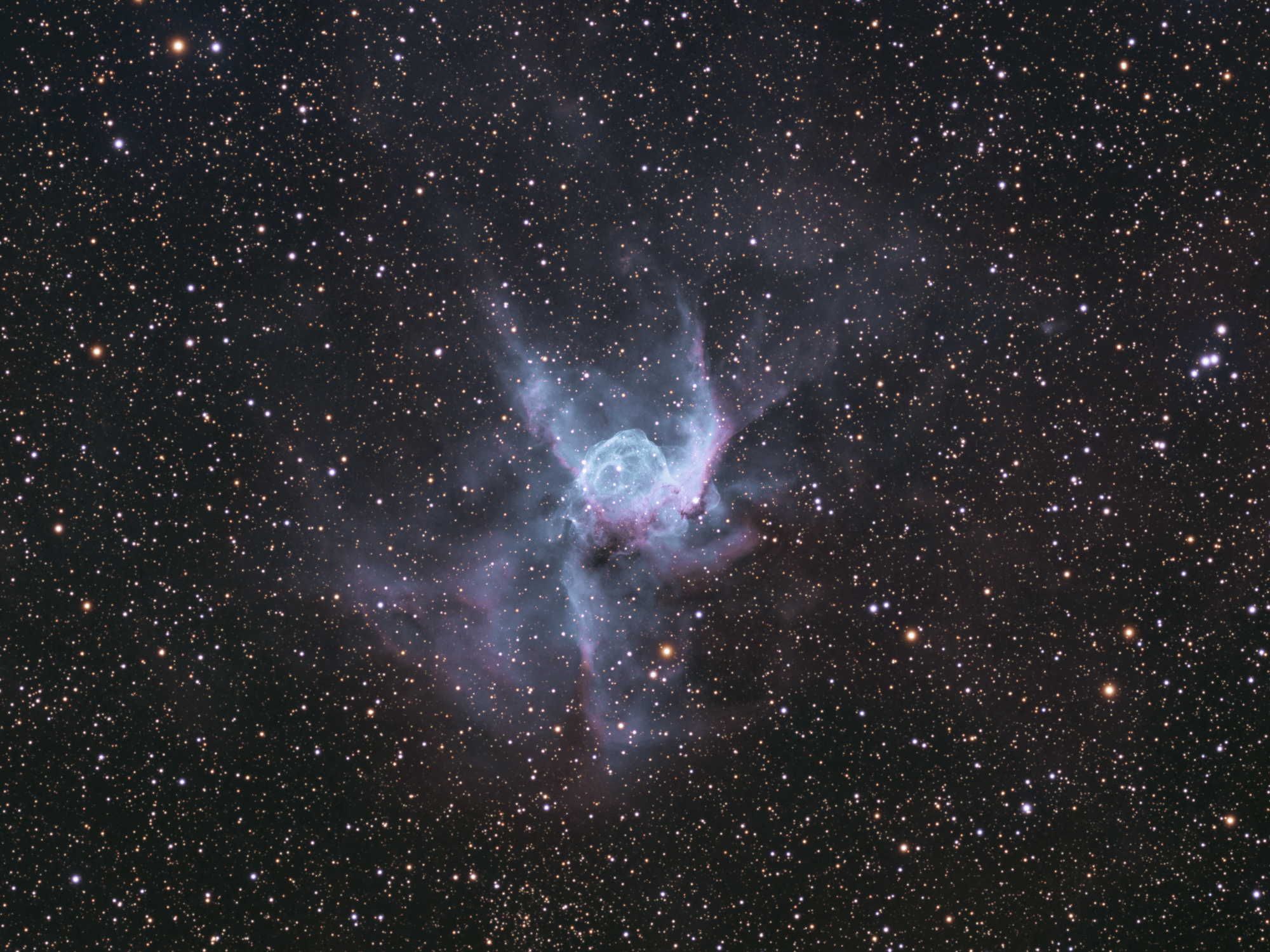
Thor's Helmet in lrgbhoo. About 24 hours integration. Stars, nebulosity and luminance all processed separately. Shot in suburban Canberra, Australia.
Downsized for posting.
Thanks @mabula-admin, @artem for the kind comments.
I thought I might describe how I created the synthetic luminance, as it is a new technique - for me at least. Might be useful for others.
I started with a normal (drizzled) integration, producing stacked files for each filter (lrgbho). Then I cleared APP and loaded the luminance, Ha and Oiii stacked files as if they lights and told APP that they were all Luminance. Then I stacked these three files using the "maximum" integrate setting (rather than "average" or "automatic") - resulting in the maximum value for each pixel. This gave me a high quality Luminance stack that was very easy to denoise and sharpen. Then I just layered this onto a "rgbhoo" file from the rgb combine tool and it needed very little extra processing. I'm not describing the extra steps where I separated the stars and added them back at the end.
I used to sometimes create a synthetic luminance by selecting "integrate per channel and all" under "multi-channel/filter options", but I always worried that this would average down pixels that were bright in one filter and dark in another. This method seems to work better, although perhaps not for every target.
I'm guessing this technique might even work well for a osc camera, ie by separating the rgb channels and doing a "max" integration to produce a luminance file. I might experiment with that, although I only use osc for widefield.
JC
