
UPDATE FROM MABULA
I have had a very rough 2 months unfortunately health wise. I was struck 3x in a row with bacterial infections. The second infection occurred after a routine hospital checkup and I became very sick. I had to rest and take a lot of antibiotics. Once I was recovering and restarting work 1 month ago, I again became sick. The infection was not yet gone, so even more antibiotics and rest was needed. Needless to say, it took a lot of my energy and I needed a lot of rest.
Finally, the infection is really gone and my energy is coming back step-by-step now and I have started work again. I am terribly sorry to have kept you waiting for support. I will address all outstanding questions and e-mails step-by step and will be on the forum daily from today.
APP 2.0.0-beta47 will come soon as well, a lot of work was already completed before I became very ill, so the release is also nearly ready for you. Beta47 will be much faster actually. Many workflows will be more than 2x faster, mosaics can even be 10x faster than before because registration really received a major boost... all compared to beta46. Before I release it, I will make sure that everything is working properly and then I will release it.
I have some very bad flats from a remote telescope. They have numerous dark rings in them, I assume this is dew? I only realized this when I processed the lights to completion. Regardless, the defective flats is not my puzzle, it's what I see in APP that baffles me.
I had 6 lights of each of LRGB. The first fully processed light (CA, STAR, REG, NORM) of each channel is always clear of the ring defects. Only lights 2 thru 6 show the rings. Why is the first free of defect? It almost appears that the flat correction was not applied to the first. the Have I discovered some bug in APP 1.083.3?
Attached is a PNG from one of the defective lights. I don't see those circles in the first image of each channel.
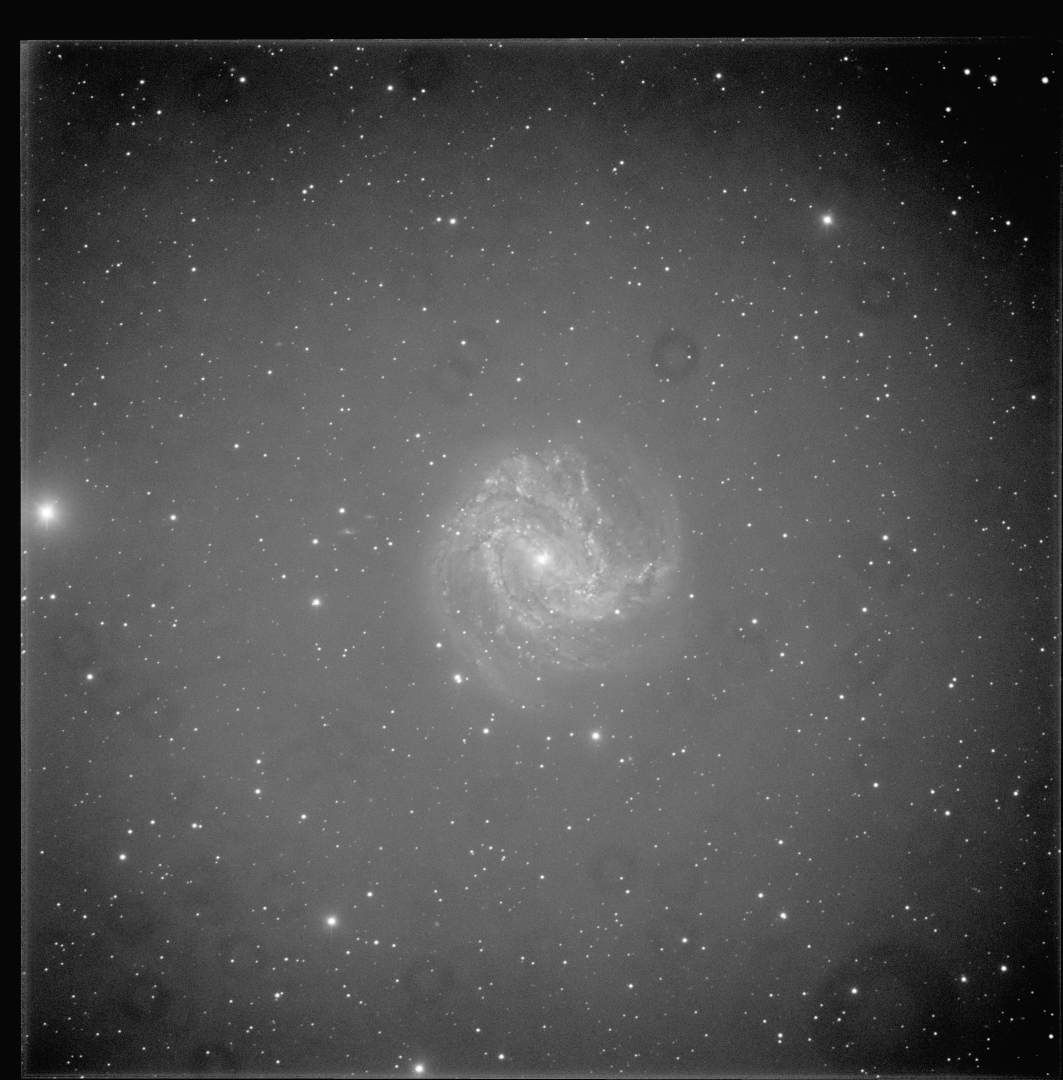
These rings are dust on the sensor. They indeed require proper flats to be removed. Personally I've seen quite a few issues with online telescope services and calibration files, so that doesn't surprise me. It appears very hard to manage that properly, remotely. So, if you have these in your result, that means either that the flats are not applied to the lights, which can be due to a mismatch of calibration data vs lights. Or the flats themselves are not ok, not calibrated well, etc.
I would need to see what you used to be able to judge this better, so if you want to upload the data (the ones that fail), including the calibration data (masters are fine for now), that would be great.
I created the upload folder as you suggested. In it are 4 files: (2) of original red light images, (1) Red MF generated by APP, and (1) Red "integrated" file.
The integrated file (isn't that the same as "stacked"?) actually doesn't look too bad, but the dust rings are obvious.
The master flats are full of dust rings. Should such flats be able to remove dust rings from the lights?
And why is it that the first fully processed light, pre-stack (CA, STAR, REG, NORM) appears to be free of dust rings, but all others are not?
Difficult to judge based in this data alone. But I am seeing a lot of dust on the masterflat you provided, so with that much it can become tricky for software to perfectly correct it. Also, there seems to be a lot of vignetting, I wonder if a flat that has been exposed longer would make better flats as well.
