
UPDATE FROM MABULA
I have had a very rough 2 months unfortunately health wise. I was struck 3x in a row with bacterial infections. The second infection occurred after a routine hospital checkup and I became very sick. I had to rest and take a lot of antibiotics. Once I was recovering and restarting work 1 month ago, I again became sick. The infection was not yet gone, so even more antibiotics and rest was needed. Needless to say, it took a lot of my energy and I needed a lot of rest.
Finally, the infection is really gone and my energy is coming back step-by-step now and I have started work again. I am terribly sorry to have kept you waiting for support. I will address all outstanding questions and e-mails step-by step and will be on the forum daily from today.
APP 2.0.0-beta47 will come soon as well, a lot of work was already completed before I became very ill, so the release is also nearly ready for you. Beta47 will be much faster actually. Many workflows will be more than 2x faster, mosaics can even be 10x faster than before because registration really received a major boost... all compared to beta46. Before I release it, I will make sure that everything is working properly and then I will release it.
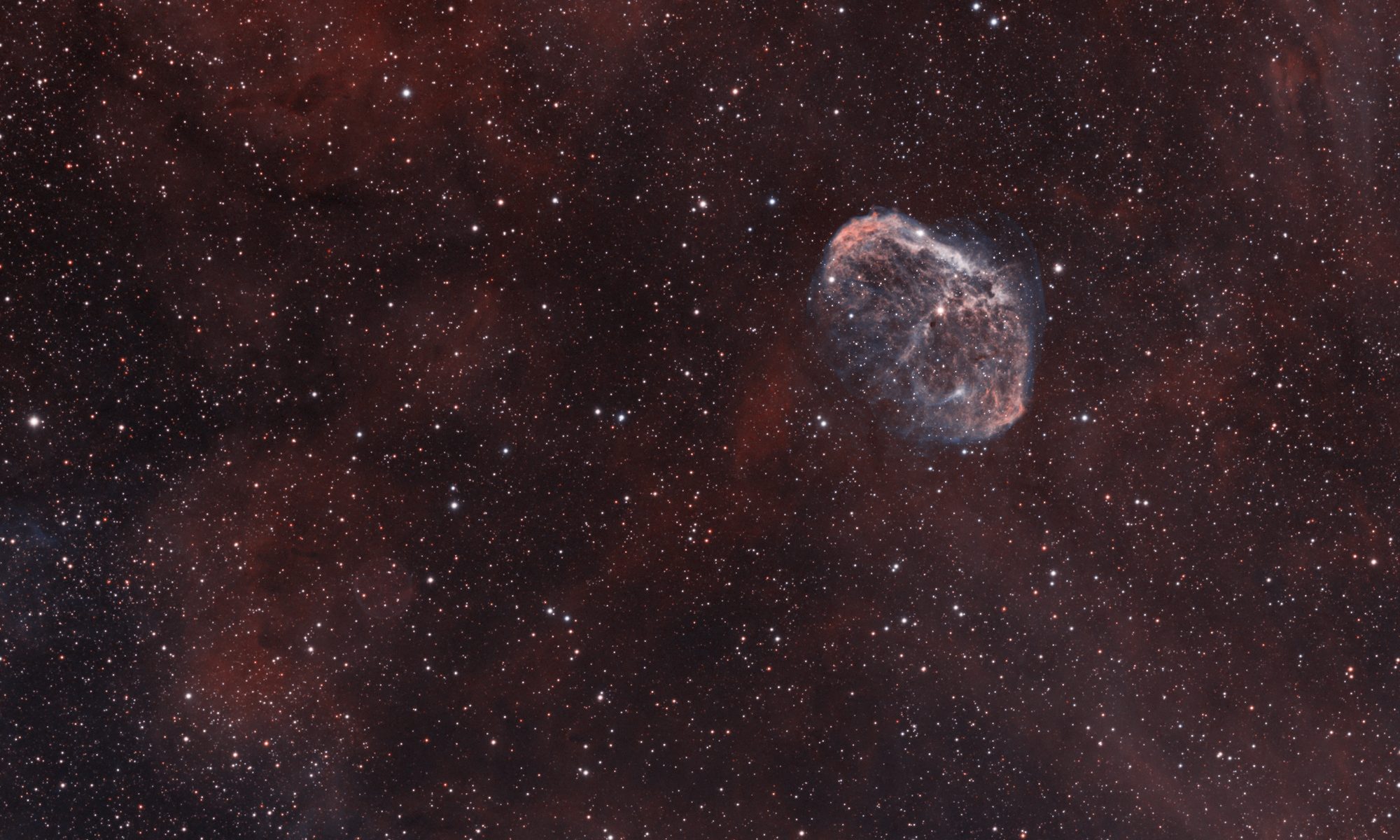
My second APP image, the PacMan. I'd always struggled to get a good Hubble palette, with the golds, reds and blues. APP Gave a great start using the color mixer and upping the Red and Blue channel multipliers.

I followed the tutorial on YouTube by Diego Colonnello. It was a great tip to add the O3 and S2 images to the Green channel along with the Ha. I did use Phootoshop to finish off the image. I really struggle with the star colors though. Any tips?
Wayne
That's looking great! Maybe slightly too much noise reduction? Hard to tell from this resolution.
Did you try a calibration of the star colors using APP?
I did try calibrating with APP, but being a narrowband image in Hubble palette I got some odd colors. I know Mabula said you could use an RGB star image from the same field to calibrate, but don't know how to do this.
I used the Photoshop noise reduction tools, so maybe too much. Looking forward to APP having more NR capabilities
Thanks, Wayne
That will be in the pipeline for sure as I think he's going to focus a bit more on post-processing. The calibration of narrow-band with RGB data I've personally never done so for that I would need his advice as well. 🙂
Hi Wayne @whixson and Vincent @vincent-mod,
Great Pacman 😉 ! Very nice colors..
I did try calibrating with APP, but being a narrowband image in Hubble palette I got some odd colors. I know Mabula said you could use an RGB star image from the same field to calibrate, but don't know how to do this.
I used the Photoshop noise reduction tools, so maybe too much. Looking forward to APP having more NR capabilities
Star Color Calibration with the Black Body models will only work well with broadband data. If you have only narrowband data, the Black Body assumption that a star emits radiation like a blackbody does not hold for such a narrow filter bandpass. So in that case, it's best to use the RGB balance model in Star Color Calibration, or try to get good colors yourself using the multipliers in the RGB Combine tool.
I know this can be a little bit tricky, and it needs some experience to get nice results.
For creating Narrowband composities, I am planning to implement presets for the different kinds of composites, like SHO (Hubble) and bi-color HaOO for instance.
Regarding using RGB data to star color calibrate Narrowband data: this is really not possible I think. The narrowband data will be missing information needed to get the colors the same as RGB data. So a complex color matrix will not achieve this I would think. Probably it's best to add RGB data as well for better star colors.
By the way: mixing the SII and OII into the green channel besides H-alpha will indeed give you better stars to start with for a SHO composite.
Kind regards,
Mabula
Thanks Mabula. I LOVE the color combine tool. I shoot mostly Narrowband to mitigate light pollution, but I kind of dreaded processing to get HOO or SHO. Yes you can use Selective Color in PS but it’s less than satisfactory. I can get a reasonable HOO or SHO in 20-30 minutes depending on object. My main challenge is keeping from too much background color when using the channel multiplier sliders at high values. I do find creating a luminance frame during integration and pumping that multiplier up helps, but some way to protect the background would be nice.
