
2026-10-09 APP 2.0.0-beta48 has been released !
This is mainly a bug fix release for the reported bugs in beta47. In addition it has a significant User Interface performance improvement noticable when you need to process 1000s of images in APP.
2026-10-03 APP 2.0.0-beta47 has been released !
This is a very big release... many code optimizations/rewrites, many parts of APP are much faster and more precise, especially star analysis and registration are much faster ! Big mosaics will go much faster 🙂
And we introduce a new preview filter, which includes the new Adaptive Deep Sky Stretch and a General Levels Stretch, this has been long over due. The old preview filter (the panel on the right side to stretch and preview your data) has not been updated for a couple of years and it is a critical part of any APP session.
Adaptive Deep Sky Stretch or ADSS is a much more intuitive stretch algorithm. It is also color preserving (which is a great new addition in itself ! ) which means that the highlights are no longer bleached, color is maintained from the linear data while stretching. You can simply stretch your data using the sky background level and signal width sliders which work much easier and more intuitive. You no longer need to fiddle with the old complicated sliders with zoom buttons. All the zoom buttons for the sliders are made redundant. And you can enter slider values in the slider value fields yourself. I will make a youtube video in the coming days to explain and fully introduce ADSS. Once the video is ready, it will be highlighted on the forum.
RGB Combine upgrade !. The RGB Combine Tool has been rewritten mostly. The tool is faster and easier to use and most importantly, the Luminance slider to inject a luminance channel or channels into the RGB composite is now working correctly. It no longer bleaches the RGB colors. Combined with the new ADSS preview, you will get much better and easier great composites with great color! I will also explain this in a new youtube video.
Hi everyone, I'm a newbie in astrophotography and last year I bought an Ioptron Az Mount Pro for planetary astrophotography (unfortunately I don't see the North Star from my balcony).
A few months ago I started doing deep sky astrophotography and I think I have gotten some good results, but I would like some advice please on the treatment of a large number of poses.
I have already read the advice you have given to divide the session into several sessions, but I have a doubt.
When I have to integrate the lights obtained from the single elaborations, do I have to select multisession / multichannel or not?
Are the lights I get in each integration the ones without the suffix nm or rm?
For example I integrated M42 and for each integration I get these three files:
M42.fits - M42-nm.fits - M42-rm.fits
M42_a.fits - M42_a-nm.fits - M42_a-rm.fits
M42_b.fits - M42_b-nm.fits - M42_b-rm.fits
etc .....
To get the final image I have to integrate the files M42.fits - M42_a.fits - M42_b.fits etc .... and I have to select Multisession / channel or not?
Thanks
Antonio


@anto74 Wow that is a really good result, even if it wasn't an AltAz telescope!!!
As for your question, you don't need all the intermediate _rm and _nm images. You can load all lights from a single session into APP and go straight to tab 6 and click the integrate button. No need at all to execute each step individually. APP will take care of that. And no need at all to save all intermediate results!
Thanks for the answer 🙂
Ok, I understand that the nm and rm files do not serve my purpose, maybe I have illustrated my question wrong.
Integrating all subs from the three sessions at once is very heavy...
For example, I photographed M42 on December 20th, 22nd and 29th.
In each session I shot 300 subs and 30 darks.
I divided each session into groups of 100 subs and processed normally (from step 1 to step 6) each sub session.
For each session I have therefore obtained three final lights (0-100 101-200 201-300).
In total I have 9 final lights (3 lights December 20, 3 lights December 22 and 3 lights December 29).
Now to merge these 9 lights together I load them in step 1 and go straight to step 6, is that correct?
When I upload them, do I have to select multisession or not?
Thank you 🙂
Hi @anto74,
Excellent result 🙂 ! thanks for sharing.
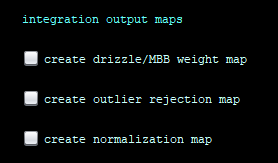
To clarify, the _rm and _nm are the RejectionMap and NormalizationMap which are only created when you enable these in 6) for analysis of how the data integration performed. These maps are only useful for analysis and don't contain any of your data 😉
Like Wouter, says, for an individual session, you can simply disable Multi-Session in 1) LOAD, load your lights and go to 6) Integrate and click on integrate 😉 All will go automatically.
Mabula
Thanks for the answer 🙂
..
For each session I have therefore obtained three final lights (0-100 101-200 201-300).
In total I have 9 final lights (3 lights December 20, 3 lights December 22 and 3 lights December 29).
Now to merge these 9 lights together I load them in step 1 and go straight to step 6, is that correct?
When I upload them, do I have to select multisession or not?
Thank you 🙂
Hi Antonio @anto74,
Indeed, to merge the 9 final lights, simply load them in 1) and go straight to 6). You don't need multi-session then. Multi-Session is only needed when you use different calibration files (dark, flat, bias, darkflat) per session. Since you have integrated them. Data-calibration is no longer needed and thus Multi-Session is not needed.
To possibly get beter alignment in your final result for your 9 final lights, try to 4) Register, enable dynamic distortion correction and disable the same camera and optics, because the integrations/stacks of the 100 frame batches are considered as a different camera technically. If the stars are already perfectly aligned in your result, you can ignore this advice 😉
Mabula
