
UPDATE FROM MABULA
I have had a very rough 2 months unfortunately health wise. I was struck 3x in a row with bacterial infections. The second infection occurred after a routine hospital checkup and I became very sick. I had to rest and take a lot of antibiotics. Once I was recovering and restarting work 1 month ago, I again became sick. The infection was not yet gone, so even more antibiotics and rest was needed. Needless to say, it took a lot of my energy and I needed a lot of rest.
Finally, the infection is really gone and my energy is coming back step-by-step now and I have started work again. I am terribly sorry to have kept you waiting for support. I will address all outstanding questions and e-mails step-by step and will be on the forum daily from today.
APP 2.0.0-beta47 will come soon as well, a lot of work was already completed before I became very ill, so the release is also nearly ready for you. Beta47 will be much faster actually. Many workflows will be more than 2x faster, mosaics can even be 10x faster than before because registration really received a major boost... all compared to beta46. Before I release it, I will make sure that everything is working properly and then I will release it.

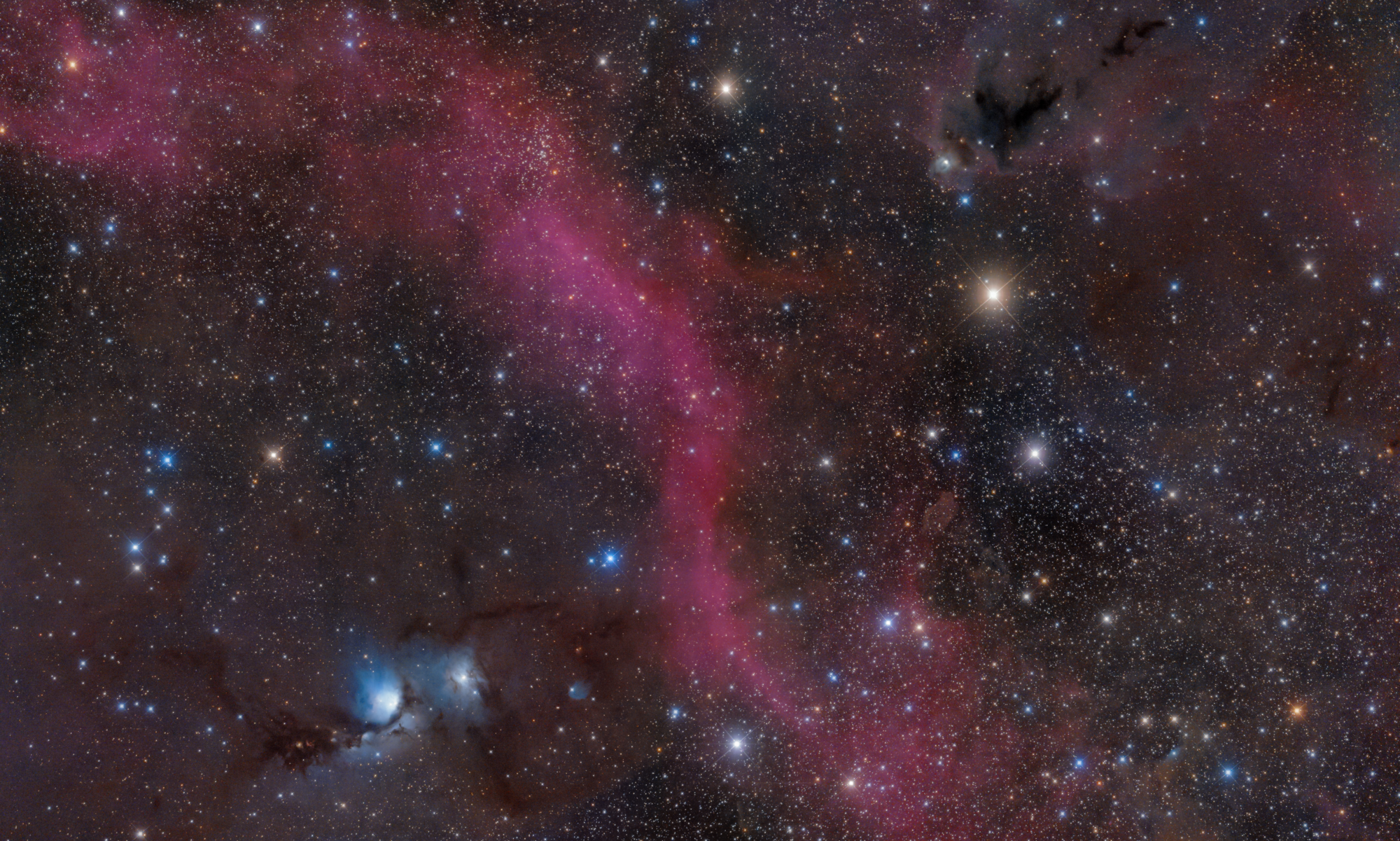
Does anyone have an opinion about where the vertical light bands on the left and right edges are coming from? This required so much cropping that I wasn't able to get it all and keep the large nebula intact. This image was the result of 310, 60 second subs using a RASA 8 at F/2, an Optolong L-extreme filter, and a ASI533 OSC camera, unity gain. Dithering at every 2nd frame, 10 pixels. Flats, dark flats, and darks duly acquired and applied. There was a meridian flip as well.
Happy for any criticism or suggestions which could enable me to get a better result next time. Artifacts like this have been occurring repeatedly, and I don't know what is causing this problem.
Hi Paul,
Those edges are caused by the fact that the subs do not exactly overlap because of dithering. You see the regions where there was less signal accumulated because less frames cover those areas. You can blend those edges better by enabling MBB in tab 6. The black edges will not disappear and the only way to get rid of them is to crop.
Wouter
@wvreeven Thanks. But I DID enable MBB and I always do. This remains a serious problem.
I am between a rock and a hard place. If I don't dither heavily, I get pattern noise.
@pswilson1 What value did you set MBB to? The default 5%? If yes, try a higher value like 10 or even 15% and see if that helps.
Dithering really is useful, even if that means having to sacrifice some of the FOV. The California Nebula seems to be a pretty large object for your telescope and camera anyway and I understand that it is hard to crop that beautiful image!
Yes, default. Thank you, I will definitely try setting this MBB value higher as this problem has recurred several times.
Dear Paul @pswilson1,
I see that the difference in Field of View for your light frames changes a bit. Now in combination with the strong signal of the nebulosity I would suggest you to try:
5) Normalize, use advanced normalization
I think that should fix it 😉
If not entirely okay yet, enable LNC first degree with a couple of iterations. That should really fix it in combination with MBB 10% roughly.
Please let us know if this helps 😉
Mabula

Wow! Those suggestions made a HUGE improvement. I am embarrassed to say that I didn't even realize that normalization could be bumped up to "advanced". Plus I did run the LNC 1st degree at 2 iterations. Thank you so much for these instructions. I have learned something.
