2026-10-09 APP 2.0.0-beta48 has been released !
This is mainly a bug fix release for the reported bugs in beta47. In addition it has a significant User Interface performance improvement noticable when you need to process 1000s of images in APP.
2026-10-03 APP 2.0.0-beta47 has been released !
This is a very big release... many code optimizations/rewrites, many parts of APP are much faster and more precise, especially star analysis and registration are much faster ! Big mosaics will go much faster 🙂
And we introduce a new preview filter, which includes the new Adaptive Deep Sky Stretch and a General Levels Stretch, this has been long over due. The old preview filter (the panel on the right side to stretch and preview your data) has not been updated for a couple of years and it is a critical part of any APP session.
Adaptive Deep Sky Stretch or ADSS is a much more intuitive stretch algorithm. It is also color preserving (which is a great new addition in itself ! ) which means that the highlights are no longer bleached, color is maintained from the linear data while stretching. You can simply stretch your data using the sky background level and signal width sliders which work much easier and more intuitive. You no longer need to fiddle with the old complicated sliders with zoom buttons. All the zoom buttons for the sliders are made redundant. And you can enter slider values in the slider value fields yourself. I will make a youtube video in the coming days to explain and fully introduce ADSS. Once the video is ready, it will be highlighted on the forum.
RGB Combine upgrade !. The RGB Combine Tool has been rewritten mostly. The tool is faster and easier to use and most importantly, the Luminance slider to inject a luminance channel or channels into the RGB composite is now working correctly. It no longer bleaches the RGB colors. Combined with the new ADSS preview, you will get much better and easier great composites with great color! I will also explain this in a new youtube video.
Hello, I have 109 images made with OSC QHY268C and have 25 matching dark frames. If I stack the images using the darks, I get a super-green image. If I stack the same image set without the darks, the stack comes out normal. Any idea what is causing this?
Thanks,
Geert
@geertvdbulcke Hi Geert. When you write "matching darks" I suppose you mean of the same temperature, gain, offset and exposure time as the lights? To my best of knowledge OSC integrations are supposed to be green due to the double number of green pixels wrt to red and blue in the sensor. If you normalize the background of the green integration, does it look normal again?
Hi Wouter,
Yes, darks taken with same exposure/gain/offset/temperature. I can't work with the stacked image when I used these darkframes. Only brighter stars are seen in vivid green.

@geertvdbulcke Would you mind uploading a few of your lights and darks to
https://upload.astropixelprocessor.com/
using upload for both username and password? Create a directory called geertvdbulcke_green and put the files in there. Then I will have a look and see if I can discover what's going on.
@wvreeven I cannot enter the site, it says password is not correct but it is my username and pw for APP site.
Disregard, upload in progress 😉
FITS header does not have the info that it is an OSC file, so you have to force cfa in APP
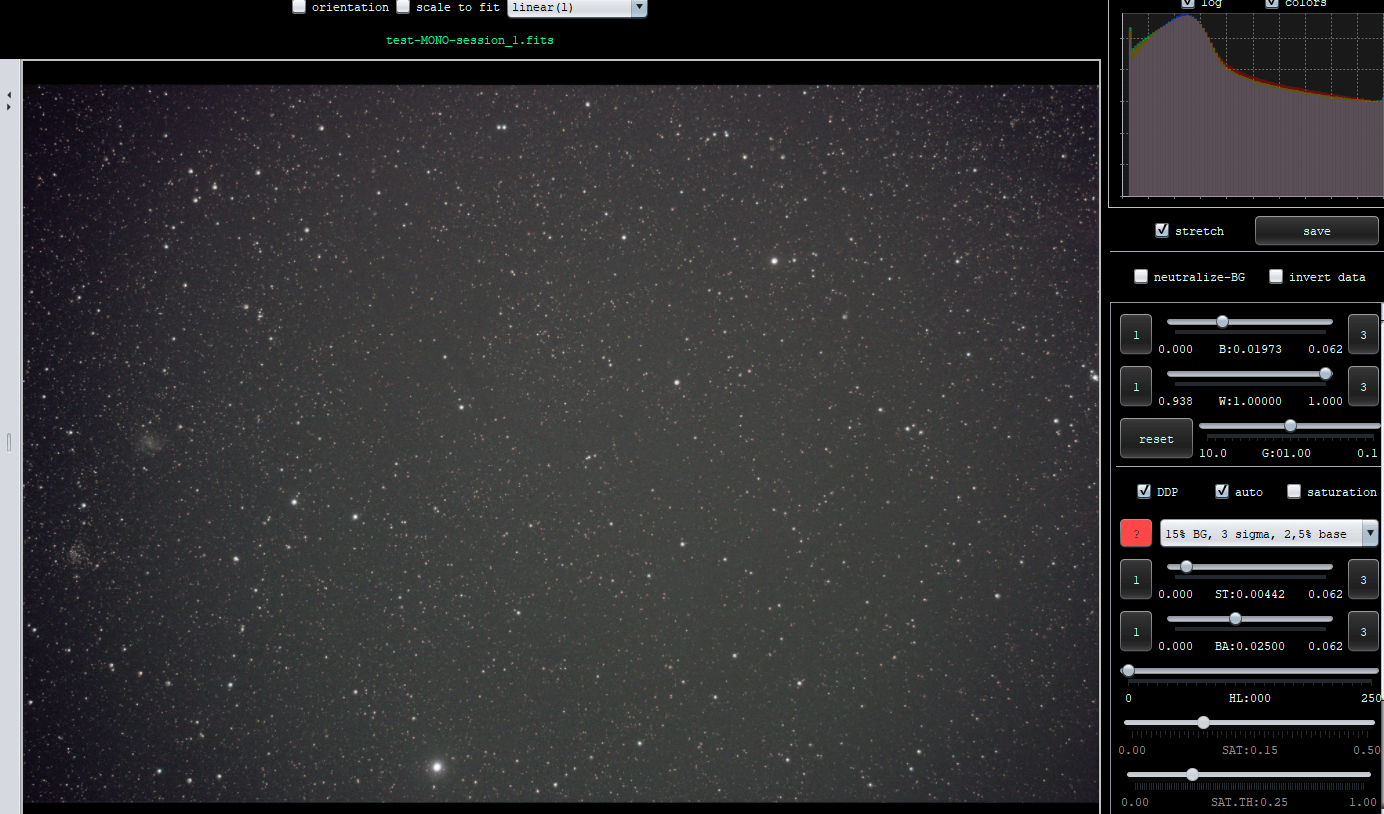
@geertvdbulcke Thanks. I downloaded 3 lights and 3 darks. When I open a light in APP, I can see the histogram as expected for an OSC camera. The green, blue and red peaks are nicely separated:

However, this is not the case for the darks:

I see the darks were shot on August 11, 2021 and the lights on September 2, 2021 but the software version and all other settings are the same. I am afraid that this is a MaxIm DL issue. Could you perhaps try to take a new dark and see if the color channels are separated like for the lights?
Thanks Wouter, this is strange indeed, I'll take a set of new darks. Actually as the camera has no shutter, I just take the images with the telescope cover on, same result in the end. I checked my other darks sets of 60s and 120s, all have the same problem. Strange enough, when I open such dark in MaximDL and do a convert color, I seem to get a color image.
@geertvdbulcke The screenshot of the dark that I posted shows that APP treats them as color images as well. See the histogram to the right. You can see that it is not grey but has colored parts. I thought it strange that the darks don't have such a separation of the channels as the lights. However, I just opened a dark taken with our ASI2600MC and it shows a similar histogram:

So I am not sure anymore what the issue is then.
I'm also taking a look, doesn't seem like the darks are very problematic actually. The data you provided I also stacked and I'm not seeing a huge issue, apart from some need for flats.
So I'm wondering if there is data in the set that is maybe causing an issue? Maybe even the flats?