
2026-10-09 APP 2.0.0-beta48 has been released !
This is mainly a bug fix release for the reported bugs in beta47. In addition it has a significant User Interface performance improvement noticable when you need to process 1000s of images in APP.
2026-10-03 APP 2.0.0-beta47 has been released !
This is a very big release... many code optimizations/rewrites, many parts of APP are much faster and more precise, especially star analysis and registration are much faster ! Big mosaics will go much faster 🙂
And we introduce a new preview filter, which includes the new Adaptive Deep Sky Stretch and a General Levels Stretch, this has been long over due. The old preview filter (the panel on the right side to stretch and preview your data) has not been updated for a couple of years and it is a critical part of any APP session.
Adaptive Deep Sky Stretch or ADSS is a much more intuitive stretch algorithm. It is also color preserving (which is a great new addition in itself ! ) which means that the highlights are no longer bleached, color is maintained from the linear data while stretching. You can simply stretch your data using the sky background level and signal width sliders which work much easier and more intuitive. You no longer need to fiddle with the old complicated sliders with zoom buttons. All the zoom buttons for the sliders are made redundant. And you can enter slider values in the slider value fields yourself. I will make a youtube video in the coming days to explain and fully introduce ADSS. Once the video is ready, it will be highlighted on the forum.
RGB Combine upgrade !. The RGB Combine Tool has been rewritten mostly. The tool is faster and easier to use and most importantly, the Luminance slider to inject a luminance channel or channels into the RGB composite is now working correctly. It no longer bleaches the RGB colors. Combined with the new ADSS preview, you will get much better and easier great composites with great color! I will also explain this in a new youtube video.
This artifact just showed up in the stack after removing the LP filter from my setup. But the circle in the middle of the image does not look like light pollution nor vignetting - maybe stray light? Could this be a processing issue? The effect is stronger when I use background normalization.
(I have an Explore Scientific ED102CF scope with Explore Scientific flattener, and ASI294mc-pro.)
I don't see the circle in the sub (1st image), only in the stack (2nd image).

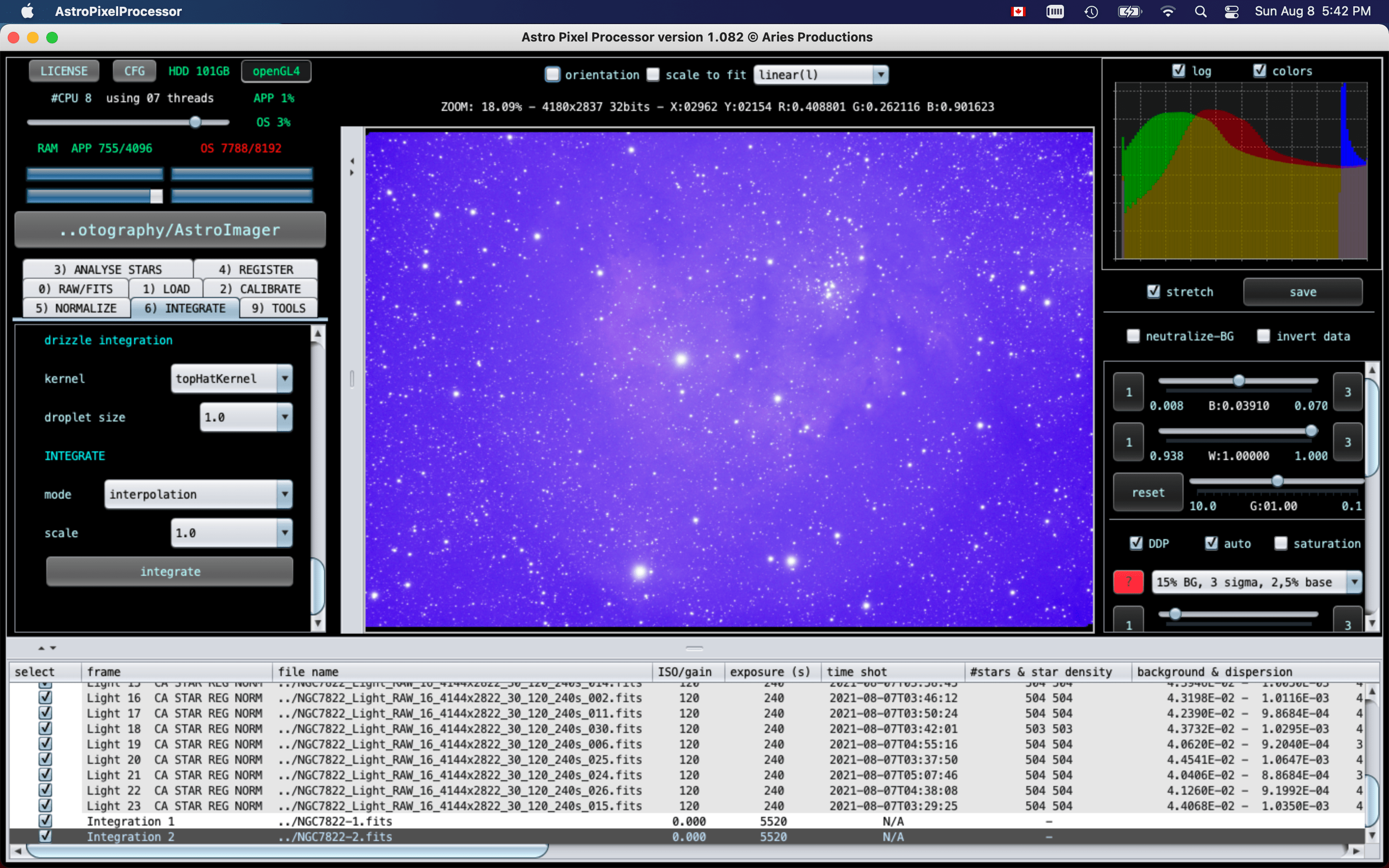
Could you switch on "neutralize BG" on the panel on the right? Just to get a clearer picture. Are you using calibration files (bias, flats, darkflats, darks)?
@vincent-mod
Hi Vincent, thanks for the reply. I'm not using any calibration in these images but the results are similar with calibration. Attached is the image with neutralize BG set in normalization.
A friend though I had a some dew on my lens but this has happened both times trying no filter and I checked there was no dew - always have the dew heaters on in this humid weather. But it made me think, could it be IR light from the dew heater, since I don't have an IR filter in these shots?

Good question, but hard to answer. Calibration data would show a bit more possibly. I would definitely look into taking those as I can also see amp-glow on the top right, which is dealt with with darks. It could be dew, maybe, as it's in the center of the image. At least I would take a very close look in the entire system for IR or other possible light sources.
Thanks, I’ll start from scratch and remove everything including FF and dew heaters and see what I find.
@astrogee Same camera, similar scope, same problem.
I've been very suspicious of dew/frost on camera window and even bought a $20 ZWO camera dew heater even though ZWO says it's not required because heat from the cooler is routed to the window. Didn't seem to help.
Was suspicious of a light leak in the image train, but everything is a screw fit now and the problem persisted.
Last two sessions I hung an opaque curtain to block two local light sources. Problem solved!
Apparently, that light was bouncing around in the dew shield and found it's way into scope and camera.
All that said, I'm still suspicious of dew or frost in the camera. I've been careful to cool to zero and then after a bit cool to -10ºC. So maybe that helped?
I don't cool to -20ºC because light pollution noise far exceeds camera noise even at -10.
All that said, I'm still suspicious of dew or frost in the camera. I've been careful to cool to zero and then after a bit cool to -10ºC. So maybe that helped?
Thanks @tailspin45, I think in this case, it should be somewhat sealed by the field flattener. But I'll keep an eye on camera dew. Lots of experiments to do on this one 🙂
