
Mar 28 2026 APP 2.0.0-beta40 will be released in 7 days.
It did take a long time to have the work finished on this and it will have a major performance boost of 30-50% over 2.0.0-beta39 from calibration to integration. We extensively optimized many critical parts of APP. All has been tested to guarantee correct optimizations. Drizzle and image resampling is much faster for instance, those modules have been completely rewritten. Much less memory usage. LNC 2.0 will be released which works much better and faster than LNC in it's current state. And more, all will be added to the release notes in the coming weeks...
Update on the 2.0.0 release & the full manual
We are getting close to the 2.0.0 stable release and the full manual. The manual will soon become available on the website and also in PDF format. Both versions will be identical and once released, will start to follow the APP release cycle and thus will stay up-to-date to the latest APP version.
Once 2.0.0 is released, the price for APP will increase. Owner's license holders will not need to pay an upgrade fee to use 2.0.0, neither do Renter's license holders.
Very new to APP & DSO processing in general & this is my take on M31.
Data is freely available as shared by Jerry Lodriguss HERE
Only 64mins of data, so not a massive amount to work with.
I found that I did 75% of the work with APP but did finish off in StarTools. I hope to be able to do far more in APP as I learn my way around.
The biggest challenge I found with this data was decreasing the over saturation in the blue channel, I know it's all subjective but to me it was too blue.
Anyway, here's what I got.

Regards..,
Kirk
Hi Kirk,
Thank you for sharing, I will have a go at the data from Jerry, will post it later 😉
Mabula
Hi Kirk,
Oversaturation in blue was not apparent to me, did you see this in APP or in Star Tools?
This is my result with 100% APP:
First the integration:
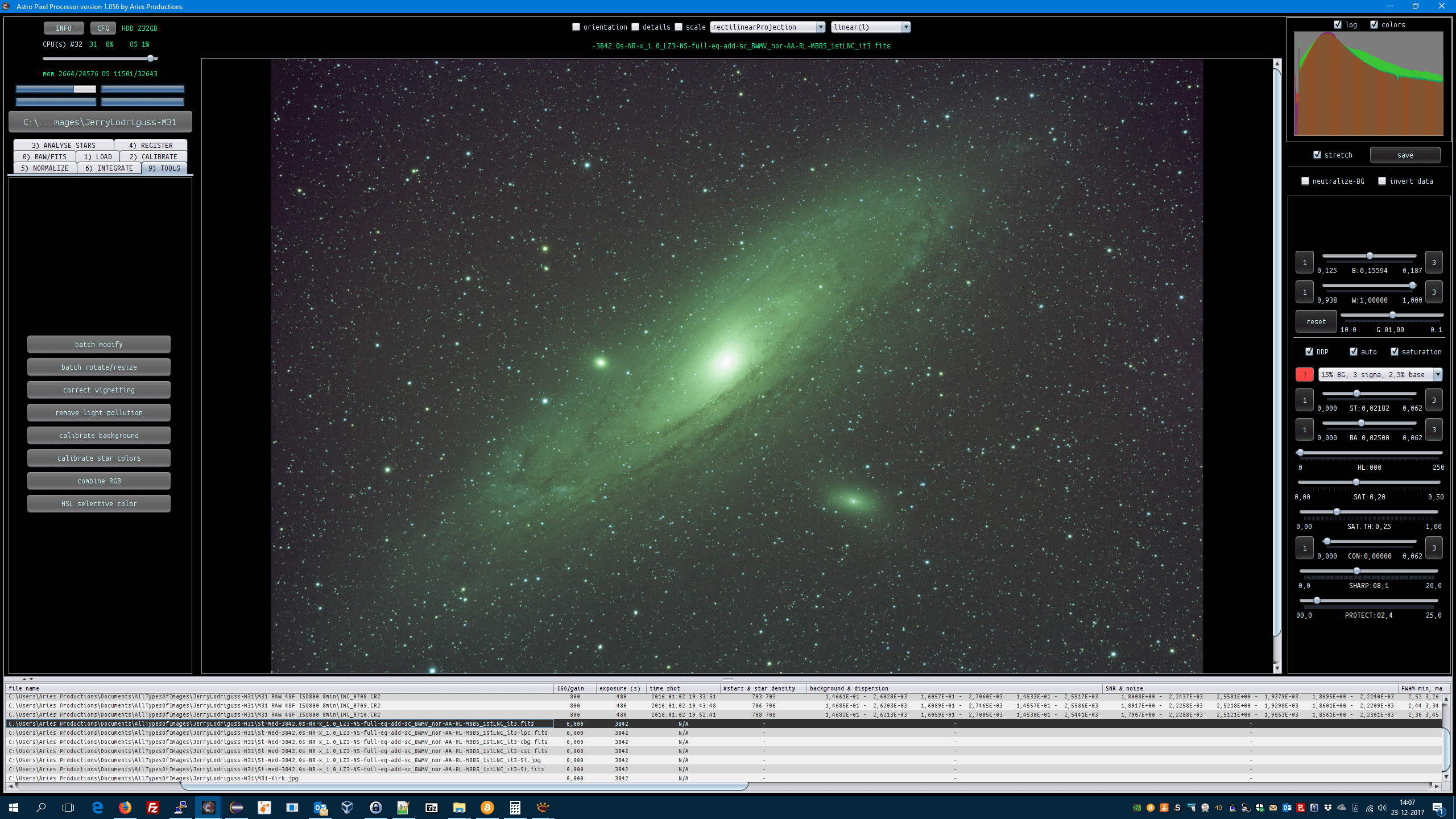
After integration, corrected the field of view with the "remove light pollution" tool, necessary due to missing flats and always present light pollution gradients:
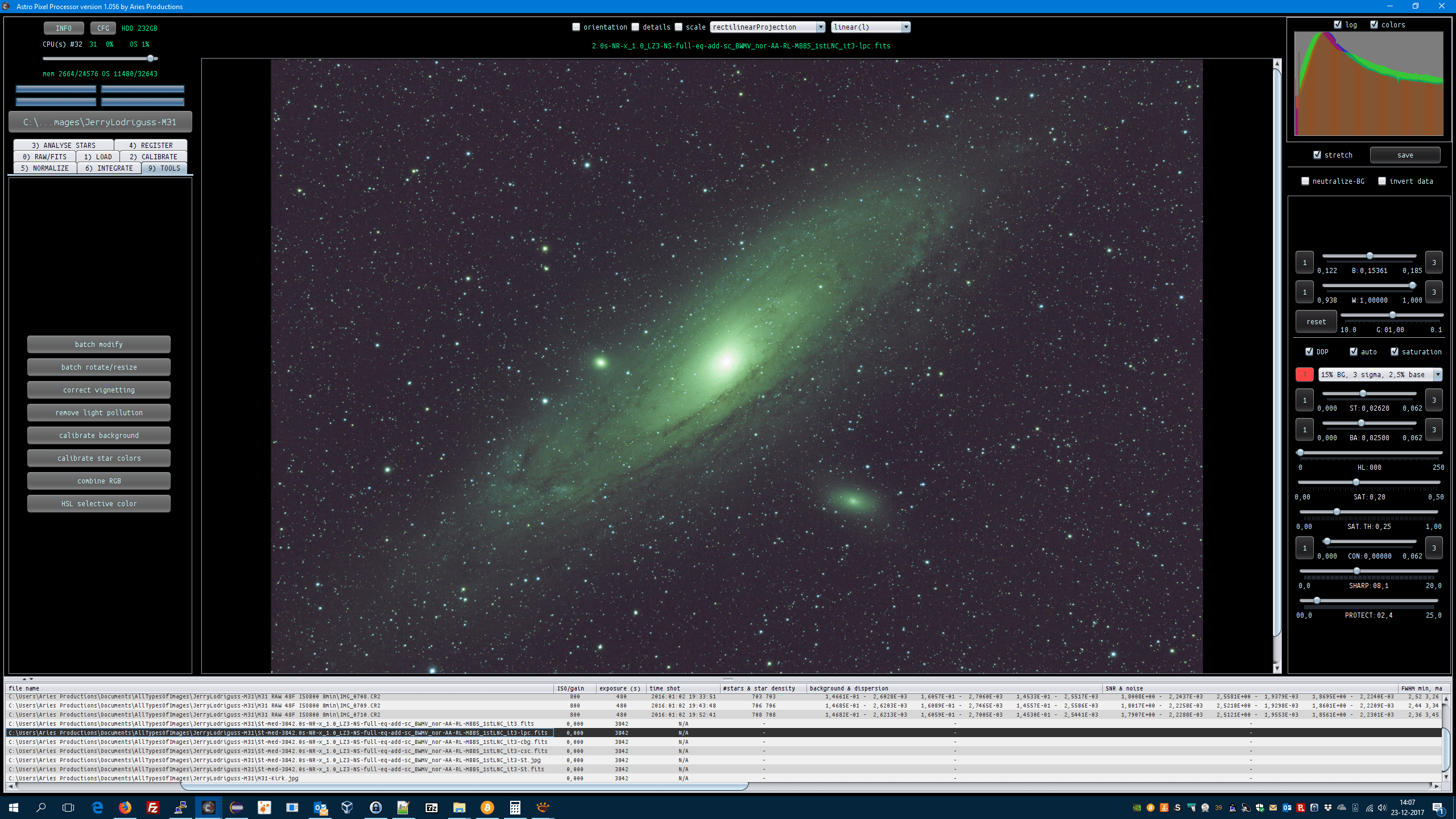
Then calibrated the background, so the background becomes gray ;-), notice the change in histogram when compared to the previous image :
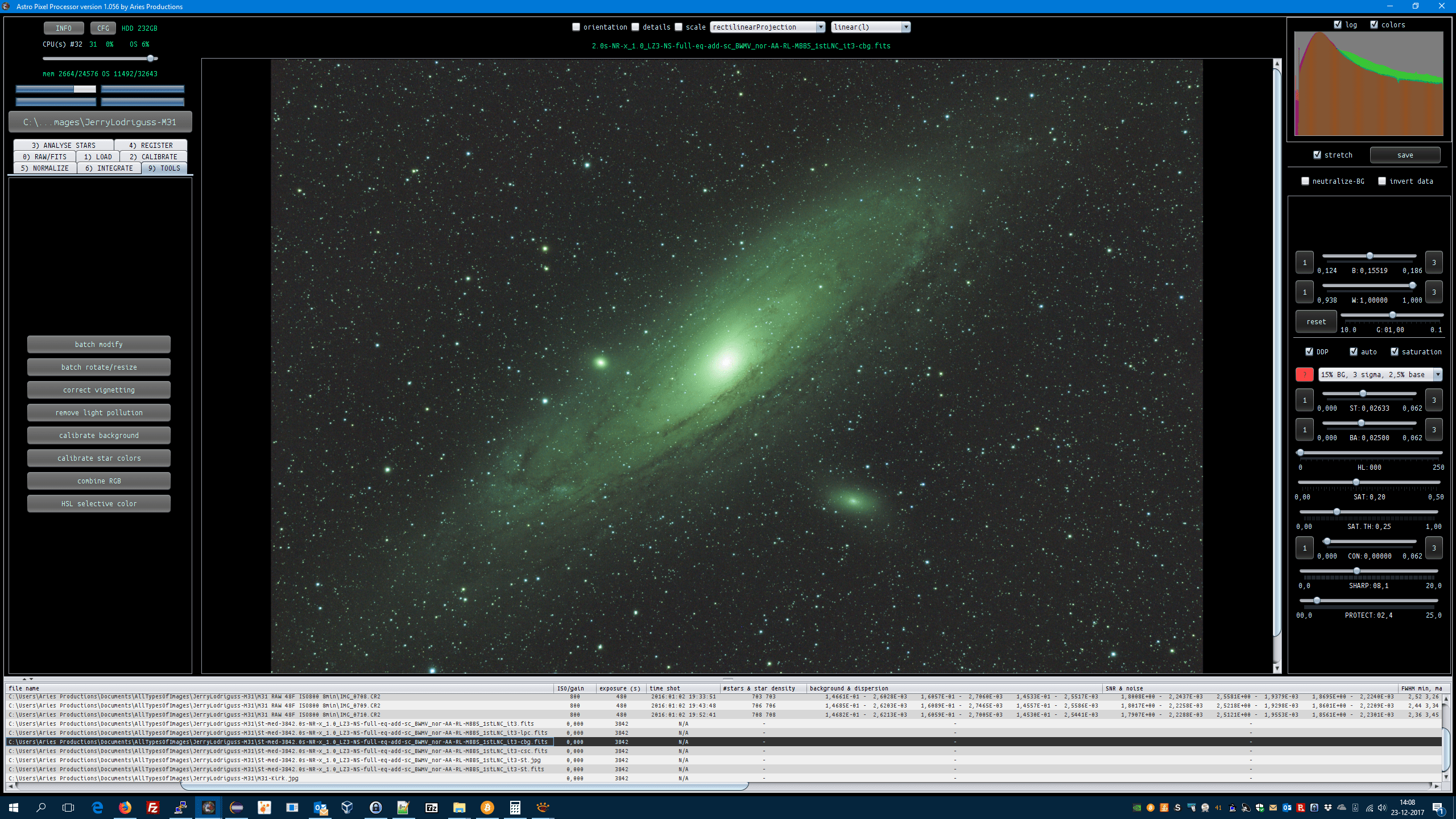
Then did Star Color Calibration, look at the parameters that I used:

Finally, this linear data, stretched, saturated with background protection and sharpness with star protection:

Jerry's own processing is seen here:

Kind regards,
Mabula
Hi Mabula,
nice result, I’ll have another go at this one I think.
Regards..,
Kirk
Hi Kirk,
For only 64 minutes of exposure time, it's nice data to play with 😉
Mabula
Is there going to be a video on Star protection this is another feature I have not experimented with?
Hi Greg,
It's the bottom slider in the preview filter on the right, check the explantion under the ? button 😉
The Sharp and Protect slider are a duo, higher Sharp will increase sharpness, and lower Protect will reduce sharpening artefacts while enhancing nebula and galaxy details. Protect 0 is no protection though, so set protection at 2-3, that is usually pretty good.
Cheers,
Mabula
