It did take a long time to have the work finished on this and it will have a major performance boost of 30-50% over 2.0.0-beta39 from calibration to integration. We extensively optimized many critical parts of APP. All has been tested to guarantee correct optimizations. Drizzle and image resampling is much faster for instance, those modules have been completely rewritten. Much less memory usage. LNC 2.0 will be released which works much better and faster than LNC in it's current state. And more, all will be added to the release notes in the coming weeks...
Update on the 2.0.0 release & the full manual
We are getting close to the 2.0.0 stable release and the full manual. The manual will soon become available on the website and also in PDF format. Both versions will be identical and once released, will start to follow the APP release cycle and thus will stay up-to-date to the latest APP version.
Once 2.0.0 is released, the price for APP will increase. Owner's license holders will not need to pay an upgrade fee to use 2.0.0, neither do Renter's license holders.
So you have used a LPS-D1 filter. Did you run this through star color calibration?
Since this LPS filter blocks part of broadband wavelengths. The slopes and constants, would need some adjusting I think. Maybe I can help here as well?
Yes i did apply the star color calibration tool, but i did used a whole different setting than you recommend at my m81 picture (see screenshot with my and you're settings).
Perhaps you could give me some advise what settings to use?
Because i live in a verry light poluted area i need to use the LPS D1 filter, now i can reach about 90 sec and the backgroud is not overexposed with only a uv/ir cut filter it is about 25 sec.
The Rosette i've shot into Emmen quite a bit better area but also light polluted so i shoose to als use the LPS D1 filter.
Yes, by looking at the images, I think the following adjustments will be usefull:
1) BG-GR slope quite a bit lower, I am guessing around 0,5-0,65
2) BR-GR slope maybe at 1,6-1,7
3) based on the redness of the rosette, I think that you want to set the Blue-Red slider to 0,10 possibly. The center of the Rossette is more pinkish, purple then which would be better.
4) current constants of 0,25 seem fine, but tweak if you think the result is either too green or magenta.
Againg sorry for the late response, i did try you're settings and the result is much better, the core of the nebula is pinkish and the star color seem to be right :).
Againg sorry for the late response, i did try you're settings and the result is much better, the core of the nebula is pinkish and the star color seem to be right :).
Yes, in RGB broadband, you don't expect the Rosette Nebula to be only Red. Especially the core should be a little bit pinkish 😉 There are glowing Hydrogen atoms that emit on the H-alpha wavelength, but also Oxygen atoms that glow on the OIII wavelengths. Red + a little bit blue, makes pinkish.. !
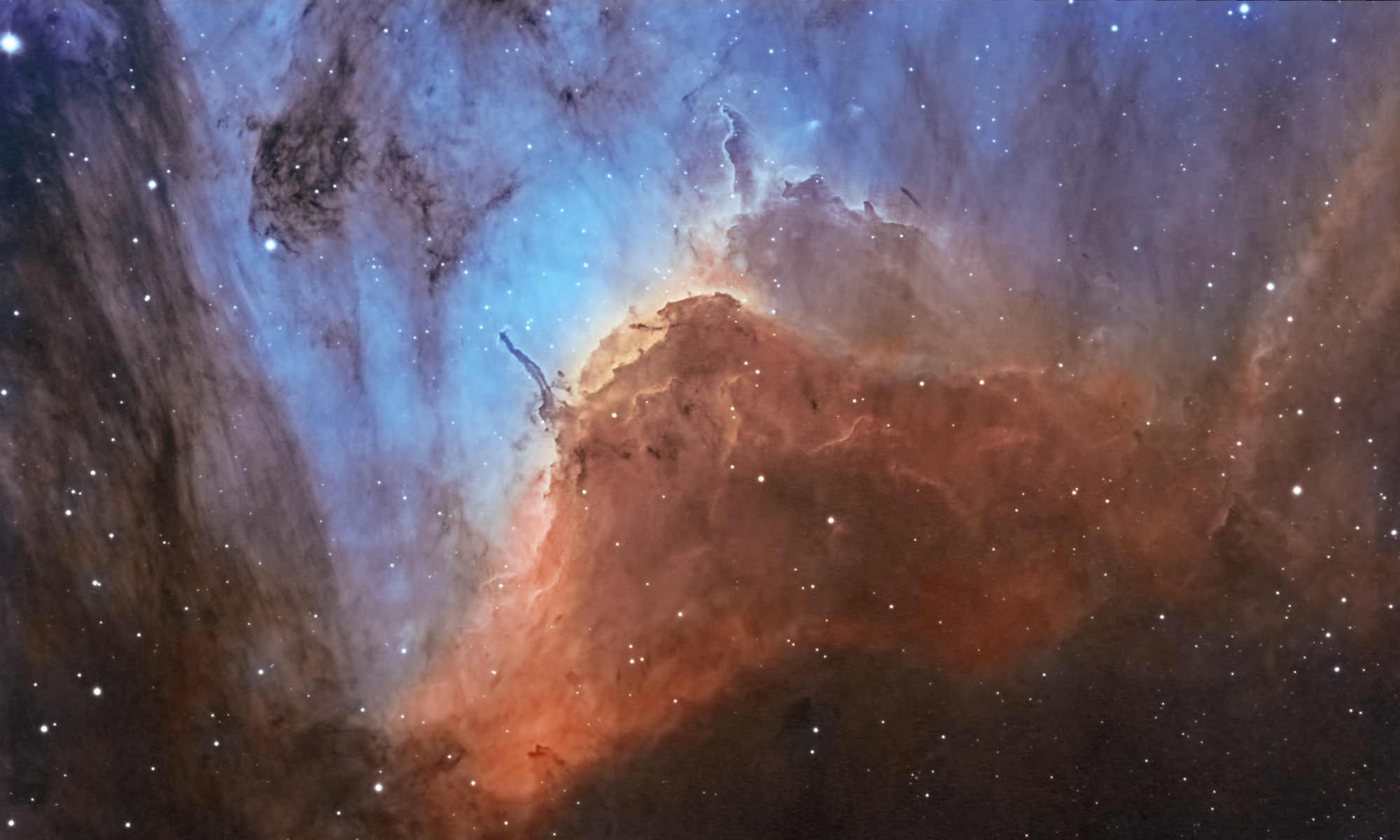
I think if you would saturate the colors more, your image will be quite similar to this Astronomy Pixture Of the Day of Evangelos Souglakos:
Thank you for you're kind words 🙂 i'm verry pleased that the colors seem to be right. Next time i will use you're settings for the Star color Calibration again.