
Mar 28 2026 APP 2.0.0-beta40 will be released in 7 days.
It did take a long time to have the work finished on this and it will have a major performance boost of 30-50% over 2.0.0-beta39 from calibration to integration. We extensively optimized many critical parts of APP. All has been tested to guarantee correct optimizations. Drizzle and image resampling is much faster for instance, those modules have been completely rewritten. Much less memory usage. LNC 2.0 will be released which works much better and faster than LNC in it's current state. And more, all will be added to the release notes in the coming weeks...
Update on the 2.0.0 release & the full manual
We are getting close to the 2.0.0 stable release and the full manual. The manual will soon become available on the website and also in PDF format. Both versions will be identical and once released, will start to follow the APP release cycle and thus will stay up-to-date to the latest APP version.
Once 2.0.0 is released, the price for APP will increase. Owner's license holders will not need to pay an upgrade fee to use 2.0.0, neither do Renter's license holders.
Hello Mabula, first big praise to the new version. The multichannel and session function succeeded. A question about the new feature Darkframe Scaling. Do the Darks then have to match the ISO and exposure time to the lights and only the temperature can differ?
Hi @minusman,
Thank you very much, it's my pleasure 😉
The dark frame scaling requires a masterbias(or bias frames which will be converted to a MasterBias) to be loaded besides a masterdark (or darks which will be converted to a MasterDark).
The scaling should correct for any deviation to the light frames, as a result of different:
- exposure time
- temperature
- iso or gain
values. So a masterdark of iso 200 shot at room temperature with sub exposures of 5 minutes can be used on light frames, with iso 800, temperature below zero..., and exposures of 15 minutes for example.
For the actual calculation, the differences in ISO/gain values and exposure times are used, as a first scale estimate. So the calculation has a reasonable starting point and should then correct for the actual temperature difference as well.
Kind regards,
Mabula
Can theoretically, the Darks then take during the day. And not necessarily at night during the recording session. Am I right?
Hi @minusman, yes indeed 😉
That should perfectly be possible. And you want to create a very good quality masterdark in that case. So make one consisting of a lot of darks so the masterdark will have very little noise.
A masterdark of 100 frames of 5minutes exposure time will be a lot better (less random noise) than a masterdark of only 10 frames of 5 minutes.
The random noise in the masterdark will always be injected in your light frames, so by using more darks, this unwanted noise injection will be reduced 😉
Kind regards,
Thanks for the info, Mabula. That sounds good. 😀
Hello Mabula, I did a test without dark frames.


And with dark frames. The SNR drops slightly but the noise also drops.


What I've noticed, at LN Mad Winsor clip are cut off parts of the image and RejectionMap looks strange. The same thing happens with other records as well.


Thanks a lot for these results.
Regarding the noise of the integration with/without darks. The lower noise result, also has lower scale/dispersion. These quintities are related. If you were to reduce dispersion with a factor 2, noise drops with the same factor. And the difference in dispersion could be due to APP having chosen another reference frame I think to which it will normalize the dispersion. The LNC has influence on the SNR as well. So it's hard to tell what the difference really is.
But I think, based on the SNR results, the integration with darks is very good. Possibly only a slight noise injection of 1-2% assuming the Signal of 2 stacks would be equal. You did use the dark frame scaling in this case or not?
Yes, i see the problem in the rejection map, I need to fix that, I have seen it myself in some data.
Thanks again 😉
Mabula
Yes that's right, APP has determined the reference frame itself. I activated the Darkframe Scaling on the Darks. I'm currently testing to calibrate to remove the light pollution. Then the integration looks even better. Makes only a lot of work a lot of frames.
What does dispersion mean?
Dispersion is a measure of scale of a distribution. See this wikipedia:
https://en.wikipedia.org/wiki/Statistical_dispersion
So it indicates (more or less) the width of the histogram peak in most of our images.
The median, is the the central value or peak of the histogram and the dipersion is how the data is spread around this central value.
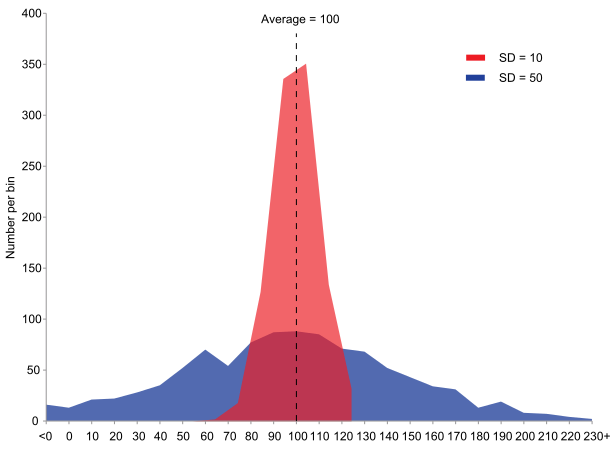
Image from provided wikipedia URL
Cheers,
Mabula
It seems a nice feature, dark frame scaling, especially for uncooled DSLR's.
My question is, al the dark frames you use for creating the master dark, has to have the same exposure time & same temperature, it doesn't correct the other way around I guess.. 😉
It seems a nice feature, dark frame scaling, especially for uncooled DSLR's.
My question is, al the dark frames you use for creating the master dark, has to have the same exposure time & same temperature, it doesn't correct the other way around I guess.. 😉
Hi @betelgeuze,
If you intend to use the MasterDark for dark frame scaling, it's certainly possible to use and mix darks of different exposure times and temperatures. I am doing this myself with my Nikon DSLRs 😉
Mabula
@mabula-admin Hi,
regarding this thread about Dark Scaling, I wanna have some questions.
I am a DSLR user and do Astro and Deepsky Astro for enjoyment. Not a hardcore Astro guy.
I understand all the basic concepts needed for this hobby. As its gonna be summer here, DSLR sensor gonna produce a lot of thermal noise. During winters, sometimes i never took dark frames but dither manually (i have a star tracker; only RA axis) as the temperature was 5-15 degrees below zero. I try to dither after every few frames. So, the point is, if i make a master dark for 50-100 frames with 5 min subs at ambient or room temperature/ different night/day, can I use them for the whole summer season? or if I make a master dark from my all darks what i have taken so far at different temperature and ISO, will it work? Now the temperature is approx 20-degree Celsius and the peak will be somewhere 35 degrees Celsius (max).
what would be a good strategy besides using dither.
thanks in advance
