

June 24 2026 APP 2.0.0-beta46 has been released !
Improved internal memory configuration (lower ! memory usage), fixed beta45 startup issue, fixed Set Save Directory & 2-panel mosaics.
May 27 2026 APP 2.0.0-beta45 has been released !
Fully Multi-Threaded LNC, many improvements for the registration engine, platform upgrade, and further tuning of internal memory consumption and memory release back to OS.
Apr 14 2026: Google Pay, Apple Pay & WeChat Pay added as payment options
Update on the 2.0.0 release & the full manual
We are getting close to the 2.0.0 stable release and the full manual. The manual will soon become available on the website and also in PDF format. Both versions will be identical and once released, will start to follow the APP release cycle and thus will stay up-to-date to the latest APP version.
Once 2.0.0 is released, the price for APP will increase. Owner's license holders will not need to pay an upgrade fee to use 2.0.0, neither do Renter's license holders.
I'm a beginner, so please forgive my huge lack of knowledge. My setup is best suited for planetary imaging, but I am attempting as many dso's as I can. My field of view is tiny (Celestron Nexstar 8se SCT on a CGEM II mount, 6.3 focal reducer, ASI 290mm main camera, ASI 120mm mini guide camera). I will be getting a refractor and different camera for dso imaging later this year. There are some great targets (galaxies) which have very few additional stars in my field of view. Sometimes APP detects only 7 or 8 stars in a sub. Sometimes star analysis fails. Other times, such as in the example I'll attach, star analysis is successful, but registration fails. Sometimes my focus is not perfect, and sometimes I have guiding issues; however, I would think that I could produce a less than perfect image from most of these less than perfect subs. I'm attaching a typical example - this is a 60 sec blue filter exposure. My gain setting was too high - I forgot to adjust it. I don't know if that has anything to do with the problem. I'm guessing that this target (M66) has too few stars in my field of view for APP to deal with it. Any advice would be appreciated!
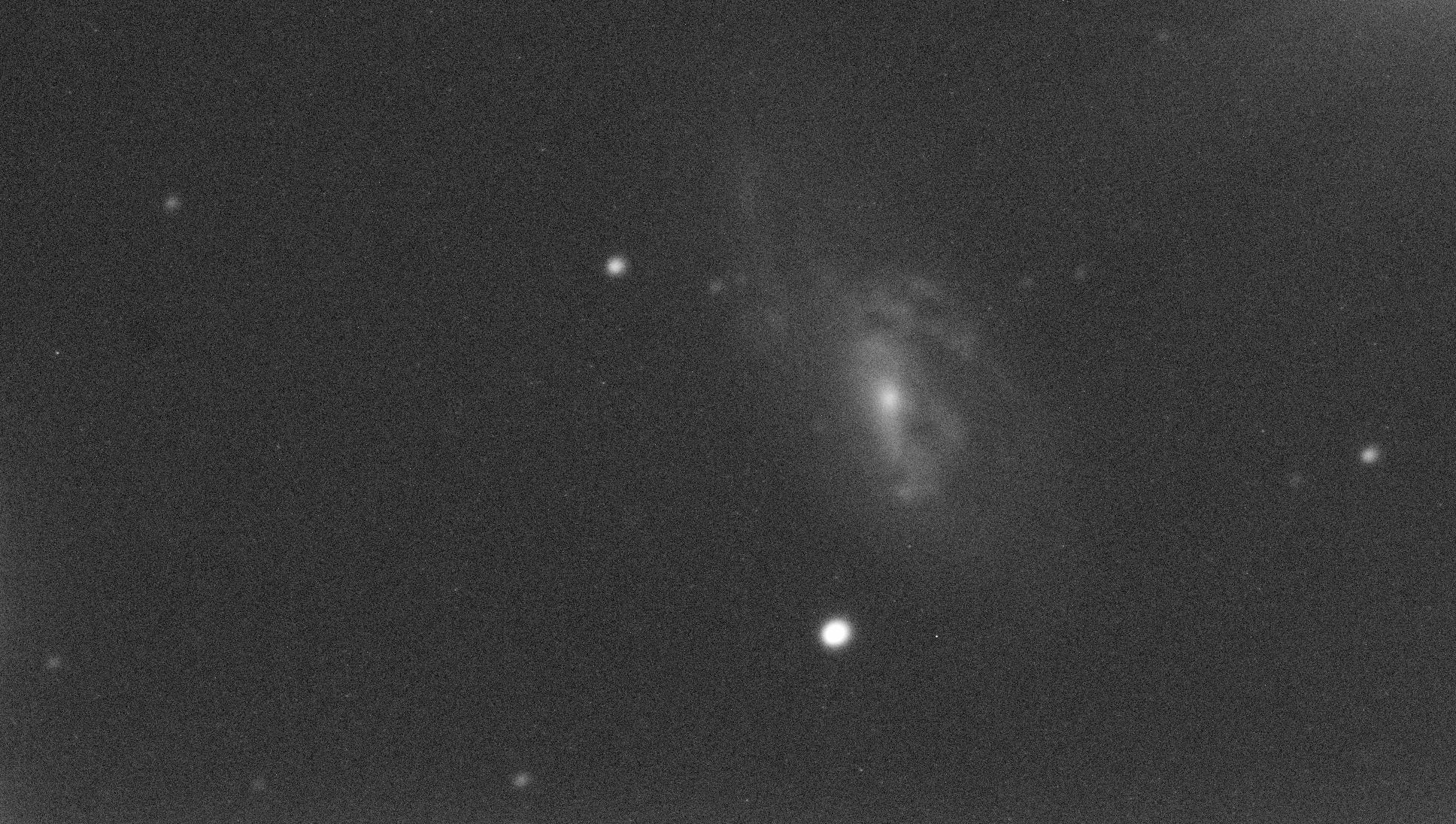
The star analysis in APP is quite advanced these days and works on many, less ideal, images. However, there will always be situation where this might still fail. It might very well be that the lack of stars in your FOV above is very tricky, maybe in combination with the noise it can fail. Do you use calibration data etc.?
No calibration data in this case. I am new to the hobby, and often don't have the patience even to take dark frames. That example had the gain setting all the way up - I simply forgot to set it lower. I am about to have 3 nights of clear skies (it's a miracle!). I'll try to get better images and shoot some darks. Also I will be looking for targets which have more stars in my small FOV. How will I know the ideal balance of exposure time and gain setting? So far I usually limit the exposures to 60sec because I don't entirely trust my guiding. I know I can google this, but I would appreciate your opinion.
