

2026-10-09 APP 2.0.0-beta48 has been released !
This is mainly a bug fix release for the reported bugs in beta47. In addition it has a significant User Interface performance improvement noticable when you need to process 1000s of images in APP.
2026-10-03 APP 2.0.0-beta47 has been released !
This is a very big release... many code optimizations/rewrites, many parts of APP are much faster and more precise, especially star analysis and registration are much faster ! Big mosaics will go much faster 🙂
And we introduce a new preview filter, which includes the new Adaptive Deep Sky Stretch and a General Levels Stretch, this has been long over due. The old preview filter (the panel on the right side to stretch and preview your data) has not been updated for a couple of years and it is a critical part of any APP session.
Adaptive Deep Sky Stretch or ADSS is a much more intuitive stretch algorithm. It is also color preserving (which is a great new addition in itself ! ) which means that the highlights are no longer bleached, color is maintained from the linear data while stretching. You can simply stretch your data using the sky background level and signal width sliders which work much easier and more intuitive. You no longer need to fiddle with the old complicated sliders with zoom buttons. All the zoom buttons for the sliders are made redundant. And you can enter slider values in the slider value fields yourself. I will make a youtube video in the coming days to explain and fully introduce ADSS. Once the video is ready, it will be highlighted on the forum.
RGB Combine upgrade !. The RGB Combine Tool has been rewritten mostly. The tool is faster and easier to use and most importantly, the Luminance slider to inject a luminance channel or channels into the RGB composite is now working correctly. It no longer bleaches the RGB colors. Combined with the new ADSS preview, you will get much better and easier great composites with great color! I will also explain this in a new youtube video.
Simple question:
How du I set a different reference frame from the one chosen by APP?🙄
Helge
When you want your own reference frame, you can go to tab 4 (register) and then on top is the button to set the reference manually. Click it and then on the frame that has to be the reference.
Ok, thank you. 👍
This error froze up APP. Had to use Windows to shut APP down. No buttons worked.
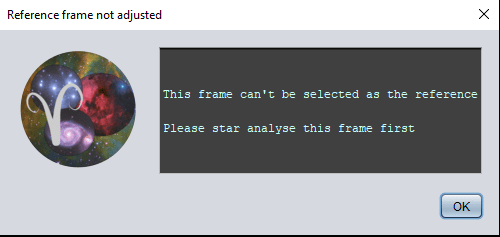
Oh interesting, I'll try to replicate that here. Did work yesterday when I indeed did the analysis first.
edit: didn't do that here, but my message is slightly different. I'm using 1.083 beta though..
Well, here is another:
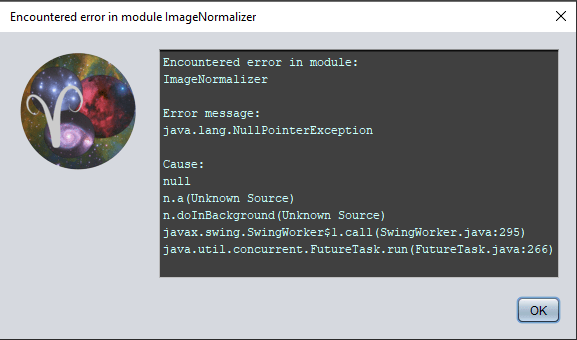
What I'm trying to do is to register and integrate a number of monochrome frames using a color frame shot with another scope/camera. Everything works fine up until integration. Preferably I want to integrate the monochrome frames only so after selecting the color frame as reference I unchecked it for integration. I have also tried including it into the integration with the same error message, but that is not actually what I want.
Not sure if I'm doing anything wrong here or it is just APP playing tricks on me.
If anybody have a bright idea, please let me know.
Edit:
I turned off LNC, and now it seems to be running. This is probably something Mabula should look into. I really would have liked to use LNC on this batch.
Edit2:
No. Failed again after a while!!! Shit! 😫
Are you normalizing a full color frame with mono? If so, that's not possible. They all should be mono then, so the color data needs to be split with the "split channels" option in tab 2 all the way down.
@vincent-mod
Not sure if I understand you, or you understand me. But let me ask this another way.
I have hundreds of color frames, some are old and need CFA to be set to produce color. (RASA8/ASI294MC)
I also have hundreds of monochrome frames to make up my luminance data. (80mm APO/ASI1600MM)
I cannot process them together because APP thinks everything is color if I set CFA and calibration fails for the monochrome frames. (This we have discussed this in another thread)
How can I get these to sets of data aligned/registered if I cannot use the same reference frame in both batches?
There must be a way to do this.
Yes, so you seem to normalize the mono frames with color and this is not possible. That's likely the underlying issue for the error.
So what I would do is to process the mono frames separately first, followed by saving the normalized frames (tab 5, all the way down and press "normalize" above that first of course). Then you clear everything (or restart APP) and load in the color data (with CFA checked). You go to tab 2, split channels and save the frames as mono. After that you can load in all data and assign them to the correct channels and APP will be able to register, normalize everything with each other and create master integrations which you can combine in the RGBCombine tool. When that data is loaded, this is also when you can set the reference frame manually like we discussed in the other post.
There are more slight variations on such a workflow, but I think it's good to try the above first.
OK. I will try this. Hope I understand everything correctly.
What do you mean by "You go to tab 2, split channels and save the frames as mono." Save the calibrated files? How or where do I save the files as mono? (I can't test much just now. Another integration is running).
So you can load in your lights and calibration data for that camera, go to tab 2, click on "calibrate" and then further down, save them with split channels selected. This will save the R, G and B mono files from the RGB lights into the working directory you selected, which you can use then as mono lights to register them to the other mono data.
@vincent-mod
OK, thanks. This time I think I understand what you mean. 😉
Will give it a shot.
