

2026-10-09 APP 2.0.0-beta48 has been released !
This is mainly a bug fix release for the reported bugs in beta47. In addition it has a significant User Interface performance improvement noticable when you need to process 1000s of images in APP.
2026-10-03 APP 2.0.0-beta47 has been released !
This is a very big release... many code optimizations/rewrites, many parts of APP are much faster and more precise, especially star analysis and registration are much faster ! Big mosaics will go much faster 🙂
And we introduce a new preview filter, which includes the new Adaptive Deep Sky Stretch and a General Levels Stretch, this has been long over due. The old preview filter (the panel on the right side to stretch and preview your data) has not been updated for a couple of years and it is a critical part of any APP session.
Adaptive Deep Sky Stretch or ADSS is a much more intuitive stretch algorithm. It is also color preserving (which is a great new addition in itself ! ) which means that the highlights are no longer bleached, color is maintained from the linear data while stretching. You can simply stretch your data using the sky background level and signal width sliders which work much easier and more intuitive. You no longer need to fiddle with the old complicated sliders with zoom buttons. All the zoom buttons for the sliders are made redundant. And you can enter slider values in the slider value fields yourself. I will make a youtube video in the coming days to explain and fully introduce ADSS. Once the video is ready, it will be highlighted on the forum.
RGB Combine upgrade !. The RGB Combine Tool has been rewritten mostly. The tool is faster and easier to use and most importantly, the Luminance slider to inject a luminance channel or channels into the RGB composite is now working correctly. It no longer bleaches the RGB colors. Combined with the new ADSS preview, you will get much better and easier great composites with great color! I will also explain this in a new youtube video.
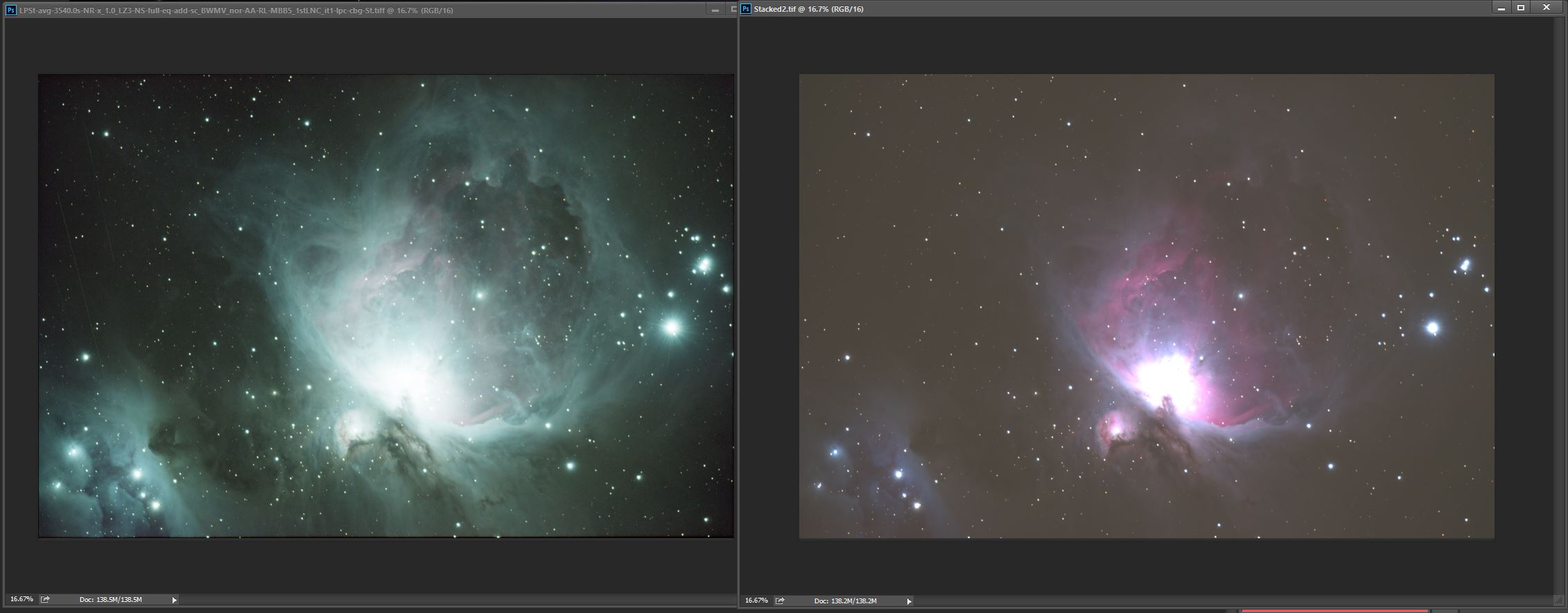
I'm trying out APP for the first time and can't figure out why my single raw images in APP look all green and unbalanced. By the time they are stacked, the image shows a lot more detail than what I've been getting with DSS which is nice, but I'm losing all the nice reds and purples I got on the Orion Nebula. See attachment for a side by side comparison after they are stacked. Any idea why? It's a D5300 camera with 12-bit .NEF files.
Hi @jlawrence904,
Welcome to the APP forum 😉
APP, by default, loads the linear raw sensor data of your NEF files, without applying camera White Balance. If the data looks green, then this is because the unaltered raw data is greenish and this is no problem, but quite normal. If you apply background correction with the Remove Light Pollution tool and then Star Color Calibration, the colors should look fine again 😉
Have a look at this topic, which will probably explain a lot with how the raw data translates to a non-linear pixel with different colors:
DSS probably is applying the camera White Balance by default? You can enable this in APP in 0) RAW/FITS by selecting camera White Balance before processing.
Let me know if this answers your question 😉
Kind regards,
Mabula
I believe the issue turned out to be the LP tool and star color tool like you said. The colors looked more balanced. It's not the deep purple color like I previously had, but I'm thinking that's okay. My colors look balanced and I see much more detail in the final processed image compared to my DSS stack.
Results can be seen here along with previous versions. Any critique is welcome: https://www.astrobin.com/322302/F/?nc=user/
Thanks for the help. One small question though-- during calibration, integration, etc... does it matter whether the "stretch" box near the histogram is checked or unchecked? Or is that only when you go to manually save a file with the save button? I just want to make sure data isn't being stretched before getting stacked, if that makes sense.
Hi @jlawrence904,
Okay, thank you for the feedback 😉
I checked your image on astrobin, perhaps the result is a bit too blue now. In star color calibration, you can adjust the calibration with the Blue-Red slider, this basically is the white star calibration. So I would try to adjust the colors a bit more towards Red, did you try that?
One small question though-- during calibration, integration, etc... does it matter whether the "stretch" box near the histogram is checked or unchecked? Or is that only when you go to manually save a file with the save button? I just want to make sure data isn't being stretched before getting stacked, if that makes sense.
No, indeed, it does not matter. The stretch selectxbox next to the save button, only applies to how you save the image when you push the save button. Normally you save the image with the stretch parameters applied. If you disable the stretch button, you will be saving the originally loaded data without the stretch parameters applied.
APP isn't doing any stretching operations in your data in 2) to 6). All data is kept linear if you have fed linear data to start with 😉
Kind regards,
Mabula
