
2026-10-09 APP 2.0.0-beta48 has been released !
This is mainly a bug fix release for the reported bugs in beta47. In addition it has a significant User Interface performance improvement noticable when you need to process 1000s of images in APP.
2026-10-03 APP 2.0.0-beta47 has been released !
This is a very big release... many code optimizations/rewrites, many parts of APP are much faster and more precise, especially star analysis and registration are much faster ! Big mosaics will go much faster 🙂
And we introduce a new preview filter, which includes the new Adaptive Deep Sky Stretch and a General Levels Stretch, this has been long over due. The old preview filter (the panel on the right side to stretch and preview your data) has not been updated for a couple of years and it is a critical part of any APP session.
Adaptive Deep Sky Stretch or ADSS is a much more intuitive stretch algorithm. It is also color preserving (which is a great new addition in itself ! ) which means that the highlights are no longer bleached, color is maintained from the linear data while stretching. You can simply stretch your data using the sky background level and signal width sliders which work much easier and more intuitive. You no longer need to fiddle with the old complicated sliders with zoom buttons. All the zoom buttons for the sliders are made redundant. And you can enter slider values in the slider value fields yourself. I will make a youtube video in the coming days to explain and fully introduce ADSS. Once the video is ready, it will be highlighted on the forum.
RGB Combine upgrade !. The RGB Combine Tool has been rewritten mostly. The tool is faster and easier to use and most importantly, the Luminance slider to inject a luminance channel or channels into the RGB composite is now working correctly. It no longer bleaches the RGB colors. Combined with the new ADSS preview, you will get much better and easier great composites with great color! I will also explain this in a new youtube video.
I started playing with mosaics. Some came out great. This one has me stumped (ASI294MC OSC, HaO3 filter)
It's a 4x4 of the Vail. There are are four panel stacks that look like this example after integrating subs with darks and flats:

and when I process the 2x2 mosaic off the four panels, it looks like this:

OK, so a lot of light pollution around the individual frame edges. Must be the almost full moon.
So I corrected all four panels for Light Pollution. Now they look like this:

That's much better. But ..
Processing the four lpc corrected panels gives me this:

What ?? How can that be ????
For reference, the next day I got this 2x2 using the same process but that day's data (and same darks, new flats). So I know it can be done. Why not the day before (I tried again, and varied a lot of the parameters. Always got more green than image ...) ??

That weird result is indeed weird, but the recommendation is to first create the mosaic (with advanced normalization and LNC and MBB enabled) and only then start with the LPC process. Does that give a better result?
Somewhat, but it seems the LPC algorith struggles a bit with odd patterns like that ..
So I played more with this, and it's becoming clear that doing LPC too early (really, before one is fully done integrating), really can mess up further steps. Below is the two 2x2 mosaics (both the "good" one and the "iffy" one from above), stacked right after integration w/ flat and darks, with a very thorough LPC (per Mabula's video) at the end, RGB combined (HaO3 and S2O3 filters), and post processing. Not too bad I think!
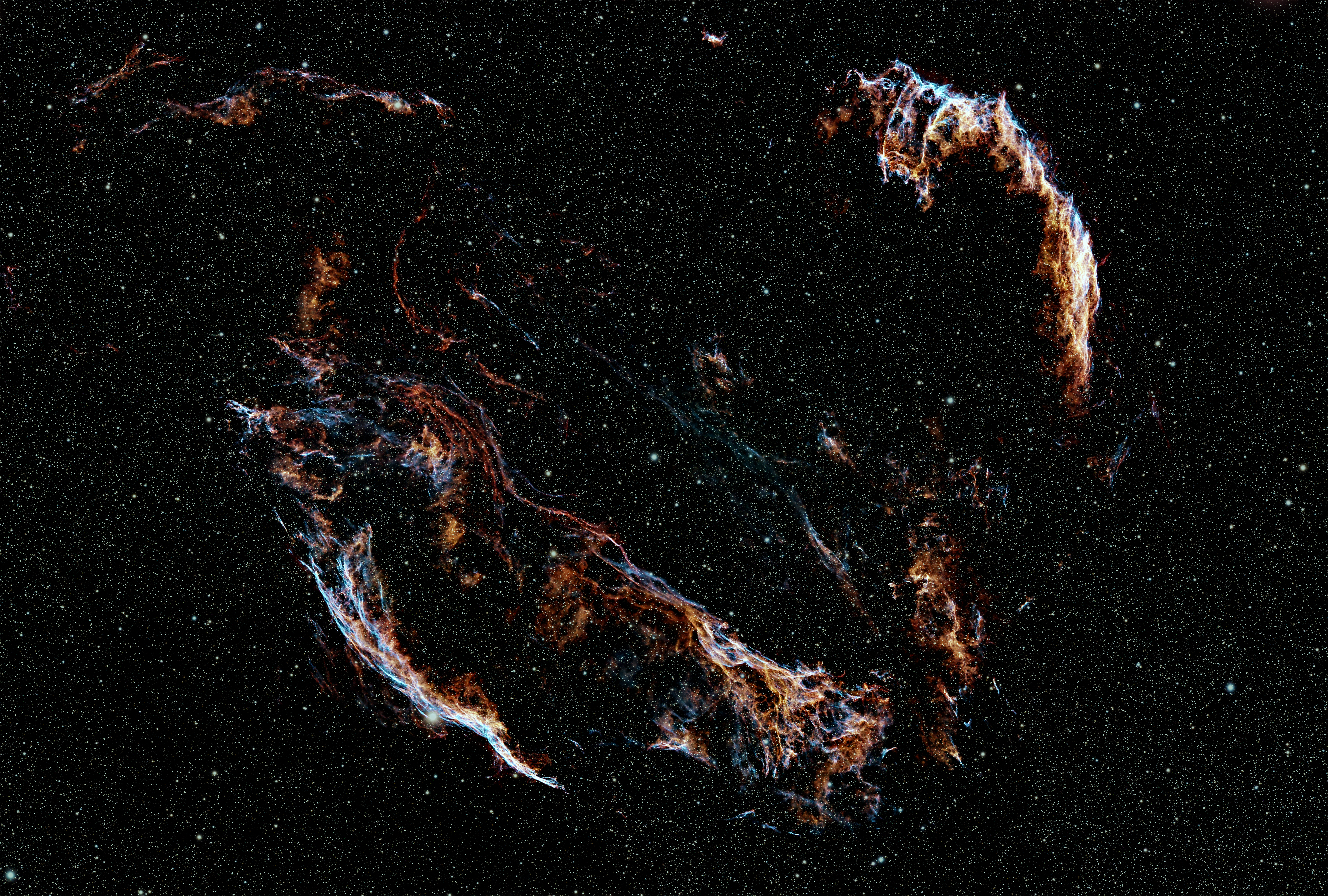
Excellent! I think that performing LPC early changes the background slightly for each panel on its own and this likely affects the mosaic normalization quite badly in your specific case. Anyway, that result looks great!
